
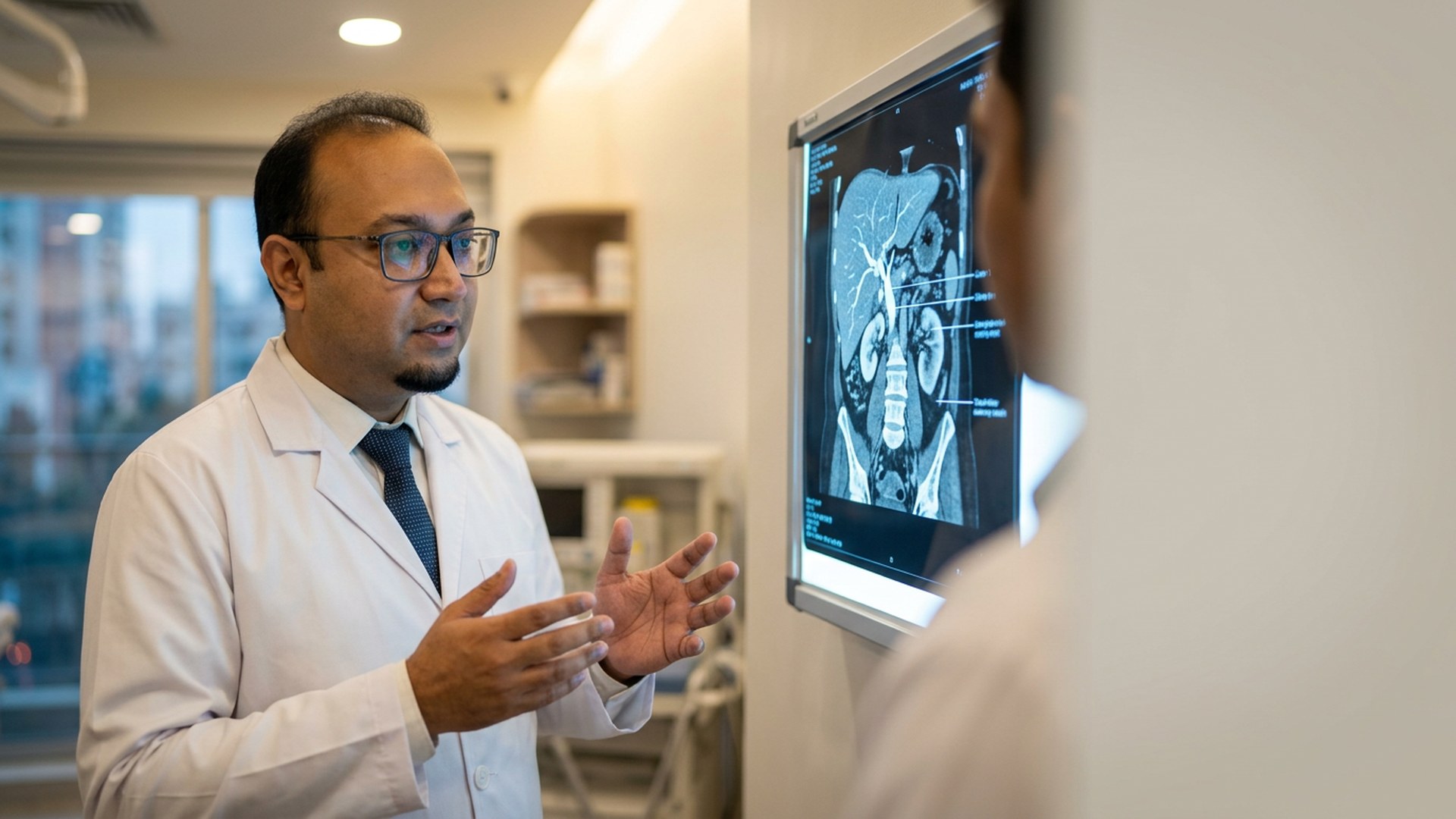
Biliary Surgery Bangladesh: Safer Bile Duct Reconstruction
If a first duct repair has already failed, a second operation can still be the right answer, because the thing that decides the result is rarely courage and almost always the sequence of drainage, mapping and timing before anyone picks up a knife.
Why Bile Duct Injuries and Strictures Need Specialist Repair
Furthermore, the bile duct is not a tough pipe. It is a thin walled channel whose blood supply runs along its edges in fine vessels, and that supply is easy to strip during a difficult gallbladder operation without anybody noticing at the time. A join made under tension, or across tissue with a damaged blood supply, heals by scarring and narrows again. That is the whole reason biliary surgery Bangladesh patients read about is treated as specialist work rather than a routine repair.
However, this is general information and not a diagnosis. The right repair depends on how high the narrowing sits, how much healthy duct is left above it, whether infection is active and whether a tumour is involved. Dr. Murshidul Arefin, FCPS, MS in Hepatobiliary Surgery (BSMMU), has performed 200+ bile duct reconstructions, and roughly 85% of those arrived as referrals from other surgeons and hospitals. If you want a considered read on your own films, get a second opinion on your MRCP before agreeing to a date.
Key Takeaways for Biliary Surgery Bangladesh:
- A failed first repair does not close the door, because the level of the stricture and the health of the duct above it matter more than how many attempts came before.
- Yellow eyes, dark urine, pale stools, itching and a wound that keeps discharging are the signs that an earlier gallbladder operation left a biliary problem.
- MRCP is the map and cholangiography shows the level, so definitive reconstruction is planned after imaging rather than during an emergency.
- Controlled drainage first, then a tension-free mucosa to mucosa join, is the sequencing that changed results, not any new device or shortcut.
- Dr. Arefin brings 7+ years of focused hepatobiliary practice and 1,500+ surgeries, and you get a written estimate before committing to anything.
Signs a Previous Gallbladder Operation Left a Biliary Problem
In addition to the obvious yellowing, the signs after an earlier cholecystectomy tend to split into two patterns. An early bile leak shows up within days: pain that will not settle, fever, a swollen tender abdomen, or bile coming through the wound or the drain. A late stricture is quieter and often surfaces weeks or months later, with itching that disturbs sleep, urine like strong tea, pale stools and a slow deepening yellow in the eyes.
Moreover, neither pattern should be watched at home. Fever with jaundice can mean infected bile under pressure, and that is an emergency rather than a clinic appointment. Somebody treated for পিত্তথলির পাথর who is now jaundiced needs imaging, not reassurance. Bring the discharge summary and operation notes from the first surgery, since they often name the difficulty that explains everything. Call Now on +880 1311 487 592 if the yellow is deepening week by week.
How a Failed Duct Repair Was Reassessed Before a Second Operation
A 47-year-old man from Dhaka (anonymous name to keep the patient private) was referred after a duct repair carried out elsewhere failed within four months.
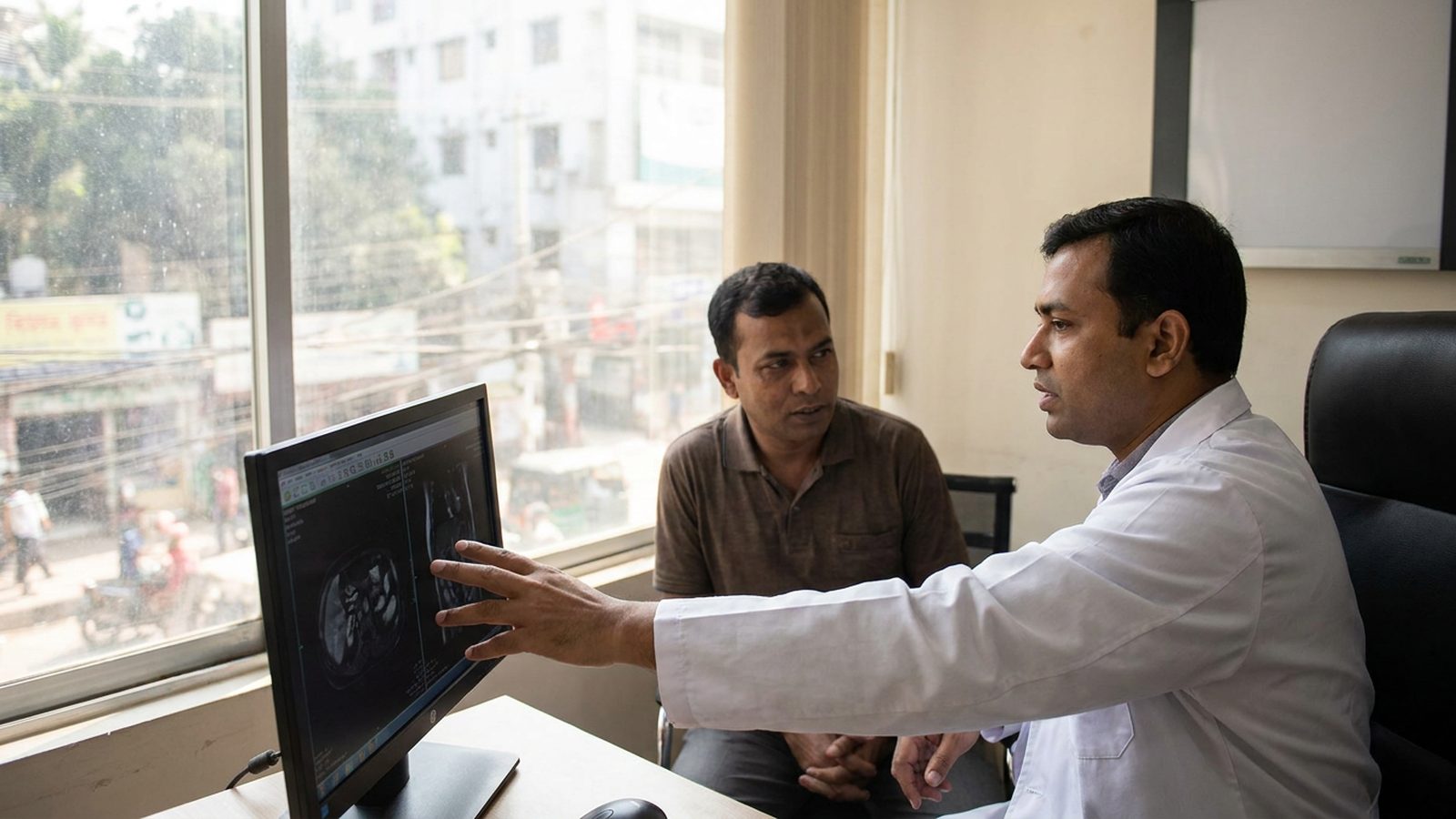
However, his story was not unusual. He had been jaundiced again, itching badly, and had already been stented twice by the time an MRCP was repeated. The scan showed a high stricture close to the confluence, with dilated ducts above it and a shrunken segment on one side. A drain was placed to control infected bile first, bilirubin was allowed to settle, and only then was reconstruction discussed as a planned procedure in Dhanmondi. In control of the conversation once he could see his own images, he brought his brother to the review and recieved a written estimate before choosing a date. No outcome was promised to him and none is promised here.
What Has Genuinely Changed in Duct Reconstruction
In addition, it is worth being blunt about what has actually changed in duct reconstruction, because the word breakthrough gets used loosely. There is no new device, no keyhole trick and no shortcut that makes a damaged duct heal on its own. What has genuinely improved is sequencing and case selection. Infected bile is drained and controlled before any definitive repair, rather than operating into sepsis. The duct is mapped properly beforehand so the surgeon knows the level of the injury before the abdomen is open.
Furthermore, the technical standard has settled. A join is made mucosa to mucosa, without tension, using healthy duct above the damaged segment rather than trimming as little as possible. Those unglamorous changes are the reason biliary reconstruction surgery results look different now than a decade ago. Nothing here cures a duct that has lost its blood supply, so honest case selection remains the first decision rather than the last.
MRCP and Cholangiography Before Reconstructive Surgery
Moreover, imaging is where a redo repair is either set up well or set up badly. Ultrasound comes first because it is quick, cheap and available across Dhaka, and it shows whether the ducts above the block are dilated. MRCP is the map: it shows the level of the stricture, the length of the healthy duct above it and whether one side of the liver has been cut off, all without passing an instrument. Contrast CT is added when a tumour rather than a scar is suspected, since it shows the vessels and any spread.
However, a map is not the same as a live picture. Cholangiography through an existing drain, or at ERCP, shows how contrast actually moves and where it stops, which is what settles a borderline level. The NHS guidance on jaundice explains why the yellowing appears at all, and the SAGES guidance on ERCP and biliary endoscopy describes what that examination involves. Bring the discs, not just the printed reports, when you come for obstructive jaundice surgery advice.
How a Hepaticojejunostomy or Duct Repair Is Performed
In addition to the imaging, the operation itself is chosen case by case rather than off a list. Duct exploration with stone clearance suits a duct blocked by stones with no scarring. A hepaticojejunostomy, a Roux-en-Y join between healthy duct and a loop of small bowel, is the durable answer for most benign strictures, because it moves the join away from the damaged segment entirely. Choledochal cyst excision is a different operation again, and the Whipple procedure is the route when a periampullary tumour is the underlying cause.
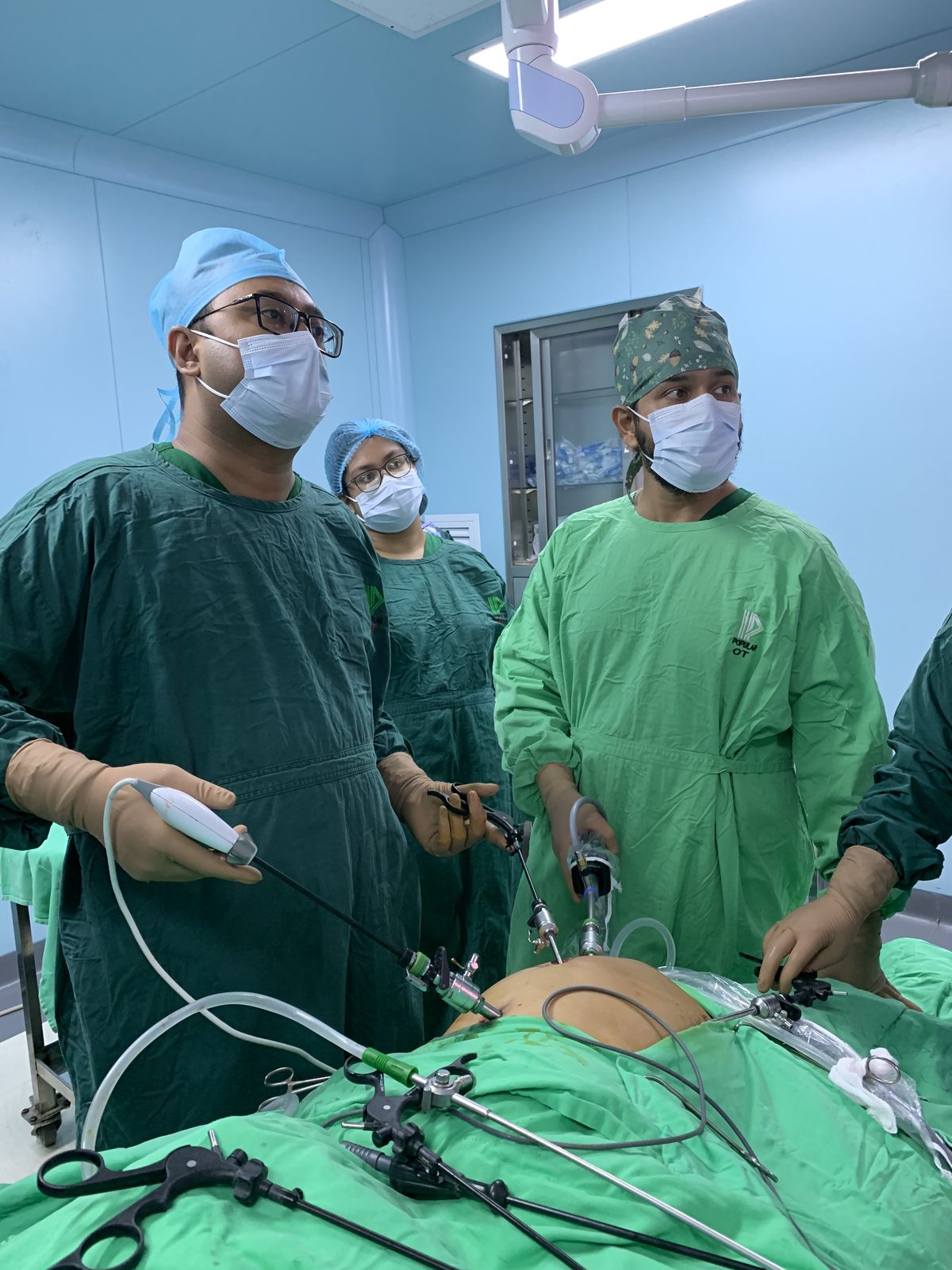
However, the access route is a judgement, not a preference. Laparoscopic surgery is used where it is safe, and open surgery where open is safer, which after previous surgery and adhesions is often the honest answer. Dr. Arefin has completed 800+ laparoscopic cases and 300+ complex pancreatic and upper-GI cases with a >95% success rate in those complex cases. Read about bile duct surgery in Dhaka before your appointment.
Documented Experience With Rare Periampullary Tumours
Furthermore, the published record matters when the cause of a block is rare rather than routine. Dr. Arefin is a co-author on a 2023 Cureus case report describing a neuroendocrine tumour of the ampulla of Vater, where the patient presented with obstructive jaundice, a double-duct sign on imaging and a dilated common bile duct, and was treated with a Whipple procedure. That is one documented case, not a series, and it is quoted here for that reason: it shows the pathway from an unclear block to a planned operation.
Moreover, he is a co-author on a 2026 Cureus study of the mean platelet volume-to-platelet ratio separating pancreatic cancer from chronic pancreatitis, which reported an AUC of 0.908, sensitivity of 83.3%, specificity of 100.0% and a cutoff of 0.053. Read that as an adjunct measurement that supports a decision already being made on imaging and endoscopy. It is not a screening test, and no single number rules cancer in or out. If your reports are unclear, get a second opinion on your MRCP rather than waiting.
Whether the Liver Can Tolerate a Resection
In addition, some biliary problems reach the liver itself, and then the question shifts from can the duct be joined to can this liver tolerate a resection. Dr. Arefin is a co-author on a 2026 Cureus study of the ALBI grade as a predictor of post-hepatectomy liver failure, which reported an AUC of 0.659, a weak to moderate result the paper does not overstate. In the same study, post-hepatectomy liver failure occurred in 0% of ALBI-1 patients, 38.5% of ALBI-2 patients and 100% of ALBI-3 patients.
However, those figures are used as they are printed, not rounded up into a promise. A weak to moderate score is one input beside imaging of the remaining liver volume, bilirubin, albumin and how you are actually functioning day to day. Publishing the work puts the reasoning on the record, which is what you should expect before agreeing to a liver-side operation.
Recovery, Liver Function Checks and Long-Term Surveillance
Moreover, recovery after biliary reconstruction is a longer arc than gallbladder surgery, and it is better to know that at the start. A drain or a stent may stay in place for a period, stents are changed on a planned schedule rather than left indefinitely, and bilirubin with liver enzymes are checked at intervals so a rising trend is caught early. No timeline here is a guarantee.
Furthermore, a repaired duct is watched over years, not weeks. Late narrowing can appear long after a good early recovery, which is why review continues once you feel well. Return sooner than your next appointment if the yellowing comes back, if you develop fever with pain, if a drain output changes suddenly or if itching returns. In control of the follow-up schedule from the first visit, you are far less likely to present late with a second stricture.
“Biliary reconstruction is a surgical procedure performed to reconstruct the biliary tract.” Wikipedia, Biliary reconstruction
Where the Surgery Happens and How It Is Organised
In addition, where the surgery happens changes how a redo repair is run. Dr. Arefin consults and operates at Popular Medical College Hospital in Dhanmondi, Dhaka, and the same surgeon who reviews your imaging performs the operation and sees you through follow-up. Scans are reviewed with radiology, and with oncology where a tumour is involved, before a plan is fixed.
Moreover, the practical side is handled openly. You get a written estimate before committing to anything, a financial-assistance pathway exists for families who need it, and recovery is run on ERAS-aligned lines so eating and walking start early. Dr. Arefin has consulted 10,000+ patients and holds 5.0 across 42+ Google reviews. Book an Appointment when you have your reports together and want a plan rather than a guess.
Arranging a Biliary Review in Dhanmondi, Dhaka
However, a useful first review needs the paperwork, so gather it before you travel. Bring the ultrasound, CT and MRCP discs with the printed reports, any cholangiogram images if a drain is in place, your bilirubin and liver panel, the operation notes and discharge summary from the earlier surgery, and your medicine list.
Furthermore, the discs matter more than the reports, because the level of a stricture is judged on the images themselves. WhatsApp or call +880 1311 487 592 to arrange a slot, or book an appointment in Dhanmondi directly. If another surgeon has already recommended a repair and you want the reasoning checked first, Get a Second Opinion before you agree to a date.
definitive #1 authority
Research-based practice: what Dr. Arefin has published
Dr. Murshidul Arefin is a research-active hepatobiliary surgeon, not only an operating one. He is a co-author of peer-reviewed, open-access studies in Cureus on albumin-bilirubin risk scoring before liver resection and on mean platelet volume-to-platelet ratio in pancreatic disease, alongside a case report on neuroendocrine tumour of the ampulla of Vater. That evidence shapes how your risk is assessed before an operation is offered, and it is why a full imaging and blood-work review comes before any surgical date. Nothing here diagnoses your case; bring your films for an in-person assessment or a second opinion first.
Frequently Asked Questions
Is a second bile duct repair worth attempting after the first one failed?
Often yes. What decides it is the level of the narrowing, how much healthy duct sits above it and whether infection is controlled first, not the number of previous attempts.
Why is MRCP needed when an ultrasound already showed a block?
Ultrasound confirms the ducts are dilated. MRCP maps the level and length of the stricture and shows whether one side of the liver is cut off, which is what a reconstruction plan is built on.
Can this be done laparoscopically?
Sometimes. Laparoscopic surgery is used where it is safe, and open surgery where open is safer, which after previous surgery and adhesions is frequently the honest answer.
How long is follow-up after biliary reconstruction?
It is measured in years rather than weeks, because late narrowing can appear after a good early recovery. Bilirubin and liver enzymes are checked at intervals and stents are changed on a planned schedule.
Independent references worth your time: NHS liver and biliary overview, PubMed biliary surgery literature, and World Health Organization health information.
Written and reviewed by Dr. Murshidul Arefin, MBBS, FCPS, MS in Hepatobiliary Surgery (BSMMU), consultant at Popular Medical College Hospital, Dhanmondi, Dhaka, who publishes peer-reviewed hepatobiliary research in Cureus. Gather your discs and liver panel, then Book an Appointment to have your biliary reconstruction options reviewed in plain language. This page is general information and does not replace individual medical advice.
Related Articles

How to Prepare for Upper GI Surgery: A Step-by-Step Guide for Patients at Popular Medical College Hospital
How to Prepare for Upper GI Surgery: A Step-by-Step Guide for Patients at Popular Medical College Hospital Preparation for upper […]
Read More
Caught in Time: A Patient’s Journey Through Pancreatic Cancer Diagnosis and Surgery in Dhaka
Caught in Time: A Patient’s Journey Through Pancreatic Cancer Diagnosis and Surgery in Dhaka In Dhaka's busy hospitals, a patient's […]
Read More
Surgical Baseline Assessment at Entry to Training
Surgical Baseline Assessment at Entry to HPB Training in Dhaka Most trainees assume the entry test exists to reject them, […]
Read More