Surgical Baseline Assessment at Entry to HPB Training in Dhaka
Most trainees assume the entry test exists to reject them, when the surgical baseline assessment is built to map what you already do well before anyone hands you a laparoscopic port.
What the Entry Assessment Measures
Furthermore, plenty of surgical training in Bangladesh starts at the operating table and works backwards, so a trainee learns a step long before anyone checks whether the underlying anatomy is secure. The entry evaluation at Dr. Murshidul Arefin’s programme runs the other way round. Dr. Arefin brings 7+ years of focused hepatobiliary practice, 1,500+ surgeries performed, 10,000+ patients consulted, and a 5.0 rating across 42+ Google reviews from the clinic side of the same practice, and that record is what the assessment set is calibrated against.
In practice, the module measures four things: hepatobiliary anatomy recall, imaging interpretation, graded operative skill on a trainer, and clinical reasoning under time pressure. However, none of it is scored as a pass or fail gate. Instead, each station produces a written profile, and that profile decides how much supervision you get in your first weeks and which cases you observe before you scrub. Moreover, the entry evaluation is deliberately uncomfortable in one narrow way: you will be asked to say out loud what you do not know yet, which is the fastest route to a training plan that fits you rather than a generic rotation calendar.
Knowledge Gaps a General Surgery Background Leaves Behind
In addition, most applicants arrive from a general surgical background where hepatobiliary exposure was incidental rather than planned. That gap is normal, and pretending otherwise wastes the first month of any fellowship. Assessing first means teaching time goes where it changes your operating, which for many candidates means biliary anatomy and imaging staging rather than instrument handling. Dhaka adds its own pressure, since referral volume is high, complex biliary cases arrive late, and a trainee who cannot read an MRCP quickly becomes a passenger on the list.
Consequently, the entry evaluation weights imaging and reasoning heavily, and weights raw manual dexterity less than most candidates expect. The standard behind the module is clinical, not academic, reflecting a practice with 800+ laparoscopic cases, 300+ complex pancreatic and upper-GI cases at a reported greater than 95% success rate, and 200+ bile duct reconstructions. Those numbers set what competent looks like at each station, and they are the reason your surgical skills evaluation is anchored to a live caseload instead of a syllabus.
Key Takeaways for the Surgical Baseline Assessment:
- Dr. Arefin leads this module with 7+ years of focused hepatobiliary practice, 1,500+ surgeries and 10,000+ patients consulted behind the standard.
- The surgical baseline assessment profiles anatomy recall, imaging reading, graded operative steps and decision making rather than issuing a pass or fail verdict.
- Trainees in Dhaka sit the module before their first supervised list so the supervision level matches real gaps instead of assumed ones.
- Every station output feeds a written training plan, a logbook target and a reassessment date you can see from day one.
- The imaging and risk-reasoning stations use real USG, CT and MRCP studies from the Dhanmondi practice, never textbook diagrams alone.
How One Registrar’s Real Gap Reset His Training Plan
A 31-year-old general surgery registrar from Chattogram (anonymous name to keep the client private) applied with three years of postgraduate experience and around forty assisted cholecystectomies. He expected the trainer station to expose him, but his port placement and camera discipline were already sound.
However, the imaging station found the real gap. Given a set of MRCP sequences, he could describe dilatation but could not name the level of obstruction with any confidence, and he could not separate a benign stricture pattern from a suspicious one. In addition, his anatomy viva showed a shaky grasp of biliary variants, which is precisely the knowledge that keeps a difficult gallbladder from becoming a bile duct injury. His written plan therefore front-loaded six weeks of imaging reading sessions and variant anatomy drills, with operative steps held at assist level until the reading improved. Not every candidate needs the same plan, and no outcome is promised here.
Knowledge and Anatomy Components of the Entry Station
The knowledge station opens the module because everything downstream depends on it. Candidates sit a written paper first, then a short viva with Dr. Arefin, and both stay inside hepatobiliary territory rather than sampling general surgery at random. Expect segmental liver anatomy by Couinaud numbering, the boundaries and contents of Calot triangle, arterial and ductal variants, portal inflow and venous drainage, and the anatomy that governs a safe critical view of the cystic duct and artery.
Furthermore, the viva probes reasoning rather than recall. Naming the right hepatic artery is a starting point; describing what a replaced right hepatic artery changes about your dissection is the actual answer scored here. In addition, the paper covers pancreatic and periampullary anatomy, biliary physiology and the vocabulary of resection planning, and candidates trained mainly on emergency general surgery lists usually score well on gallbladder anatomy and thinner on pancreatic relations. Nothing in this station is used to disqualify anyone.
Practical and Imaging Stations in the Assessment
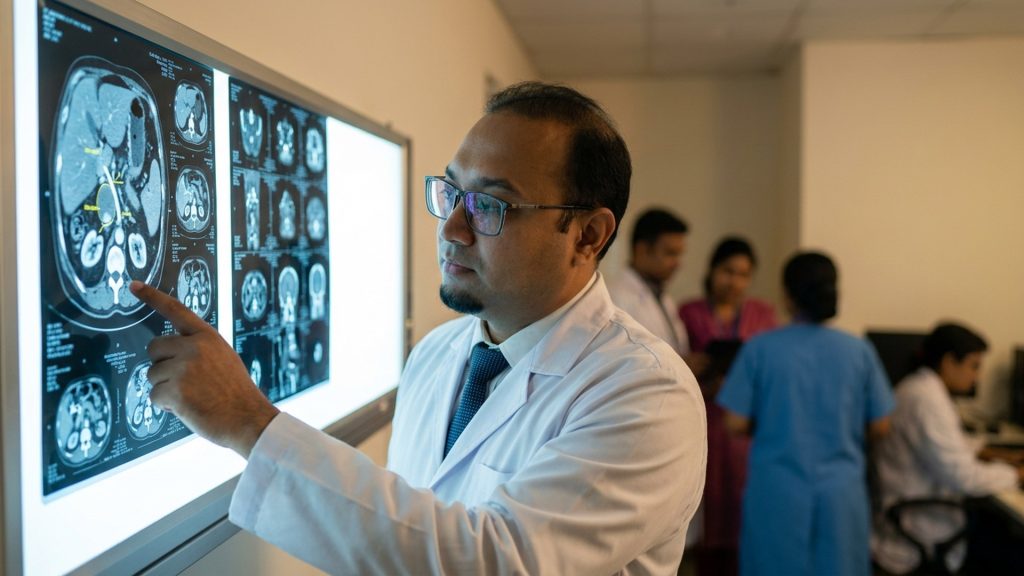
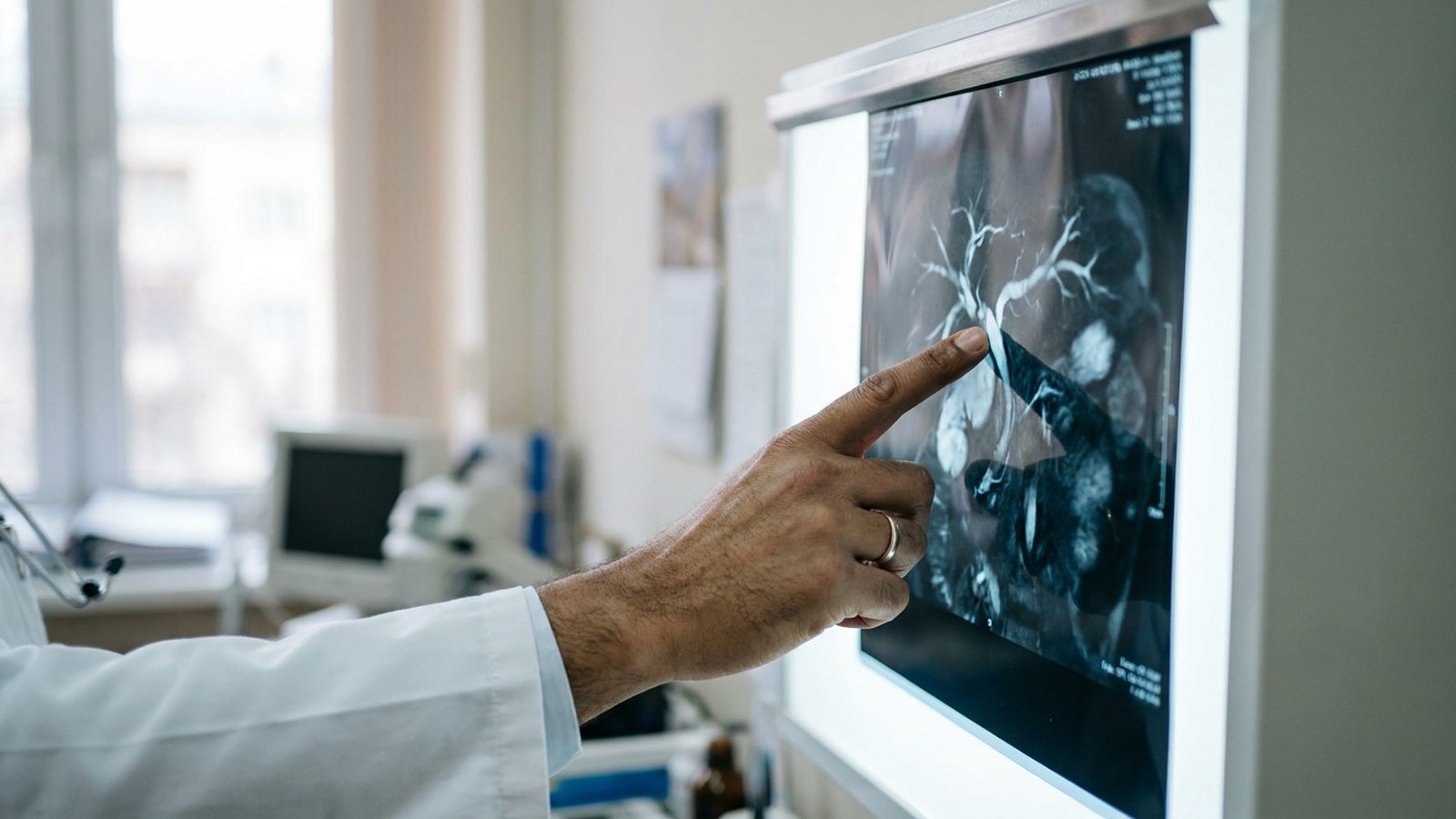
The imaging stations are where most training entry assessment profiles are decided. Candidates work through real anonymised studies from the Dhanmondi practice, not textbook plates: ultrasound first, then contrast CT, then MRCP sequences. For each set they state what they see, what they cannot exclude, and what they would order next. Ultrasound comes first because it is what a Dhaka patient usually arrives holding, and candidates comment on wall thickness, stone burden, ductal calibre and pericholecystic changes, saying clearly when a study is inadequate.
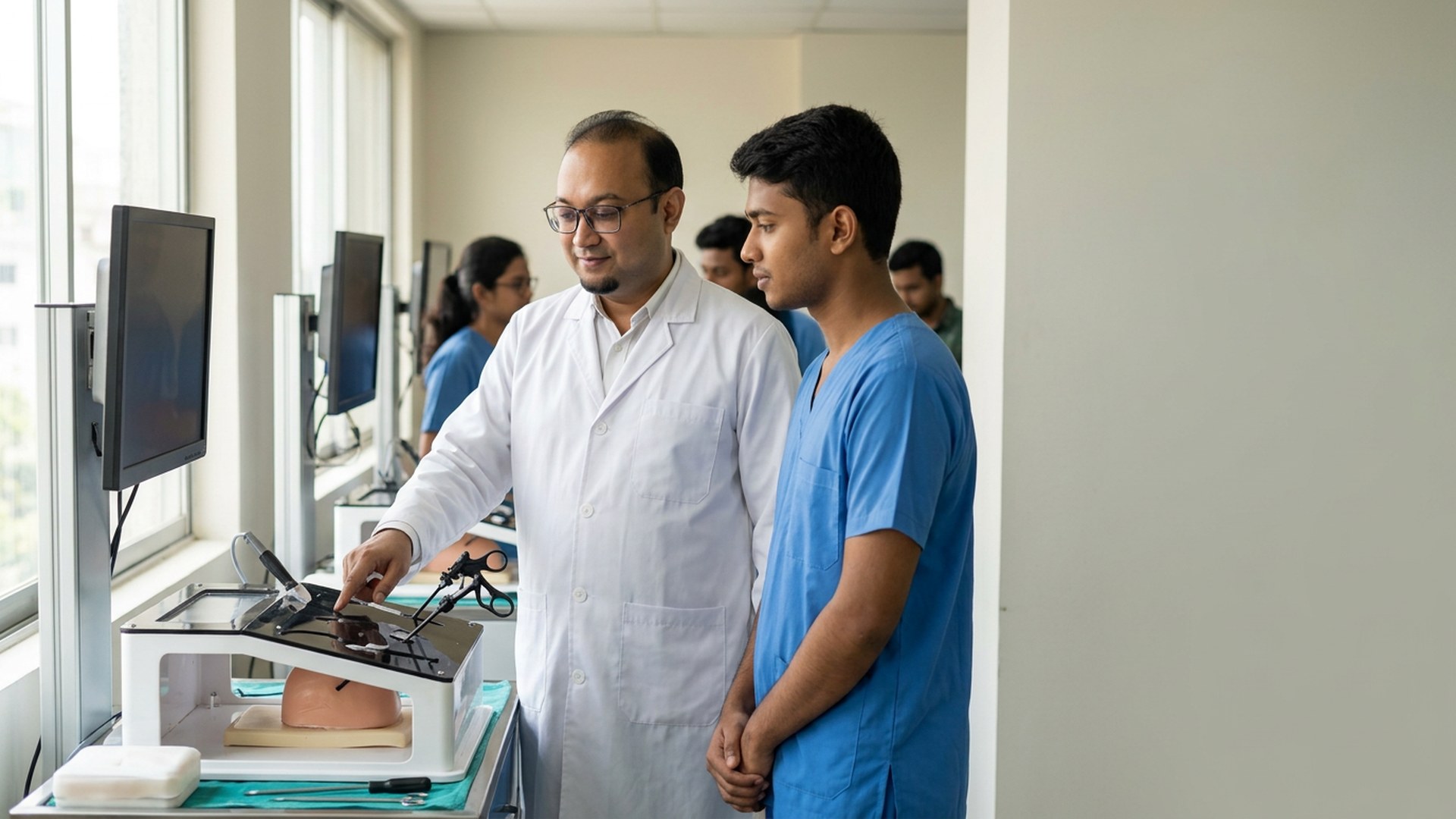
Moreover, CT and MRCP raise the difficulty, asking candidates to name the level of biliary obstruction, describe vascular relations, comment on resectability language and separate benign from suspicious stricture patterns. Radiological reporting standards used by referral centres are public, and the imaging conventions tested against follow the same descriptive discipline; readers can compare the general public overview on the NHS gallstones page. However, the station never asks a candidate to diagnose a live patient, since every case is closed and already managed. The practical trainer station follows the same discipline: camera navigation and horizon control first, then two-handed tasks, port placement reasoning on a mannequin, and a timed dissection task, alongside scored theatre etiquette and safety.
Decision Making and Escalation Behaviour Under Pressure
In addition to manual skill, the decision-making drills carry equal weight. Candidates are given a short case, a set of images, and a moment where something goes wrong, and what is scored is escalation behaviour: whether a candidate names the difficulty out loud, whether they stop, and whether they can articulate the threshold for converting to open surgery instead of persisting from pride.
Consequently, a candidate with modest instrument skill and sound judgement finishes the surgical skills evaluation in a stronger position than a fast pair of hands with no stopping rule. Manual skill improves quickly with repetition and supervision, and judgement takes longer to build, which is why the module would rather find its shape at entry than discover it mid-dissection.
Why the Reasoning Stations Follow Published Research
Moreover, the reasoning stations are not improvised. They are built from the same questions Dr. Arefin has taken into peer-reviewed work, which is why applicants meet published evidence rather than opinion at the table. He is a co-author of a diagnostic accuracy study on the mean platelet volume-to-platelet ratio for separating pancreatic cancer from chronic pancreatitis, published in Cureus in 2026.
That study ran at the Department of Hepatobiliary, Pancreatic and Liver Transplant Surgery in Dhaka across 35 patients, with histopathology as the reference standard. It reported an MPR AUC of 0.908, sensitivity 83.3% and specificity 100.0%, while CA 19-9 showed only fair discrimination. However, the paper’s own conclusion is the part trainees are tested on: MPR is a low-cost adjunctive preoperative marker whose cutoff still needs validation in larger multicentre cohorts, not a standalone or screening test. Furthermore, a candidate who quotes the AUC but calls the marker diagnostic on its own has answered incorrectly, because reading a result at its stated strength is the skill under assessment.
Operative-Risk Station: Reading the ALBI Score Correctly
The operative-risk station uses liver resection because the trade-offs there are unforgiving. Candidates are given albumin and bilirubin values, an imaging set, and a proposed resection, and are asked what the numbers do and do not tell you before an operating date is discussed. Dr. Arefin is a co-author of a prospective study on the preoperative albumin-bilirubin score as a predictor of complications after liver resection, published in Cureus in 2026.
In that 70-patient series, 30 of 70 patients, or 42.9%, developed postoperative complications, and post-hepatectomy liver failure occurred in 0.0% of ALBI-1, 38.5% of ALBI-2 and 100% of ALBI-3 patients. The score’s discrimination was modest, at an AUC of 0.659, sensitivity 70.0% and specificity 62.5% at a cutoff of minus 2.67, and age and ALBI grade were independently associated with complications while MELD did not differ significantly between groups. Consequently, the correct answer at this station describes ALBI as weak to moderate and adjunctive, and a trainee who presents any risk score as a decision rule instead of one input alongside clinical judgement has misread it.
The Periampullary Station and What It Tests For
The periampullary station is deliberately rare-disease shaped. Dr. Arefin is a co-author of a 2023 Cureus case report describing a neuroendocrine tumour of the ampulla of Vater, and that case supplies the teaching set: a woman with recurrent upper abdominal pain, ultrasound showing multiple gallstones with a dilated common bile duct, MRCP showing the double-duct sign, and endoscopy showing a bulged ampulla. A Whipple procedure followed, and histopathology with immunohistochemistry confirmed a well-differentiated grade 1 neuroendocrine tumour.
In addition to naming the double-duct sign, candidates are asked what they would have missed. Gallstones were present and would have explained the pain, which is exactly how a rare ampullary lesion gets treated as biliary colic and পিত্তথলির পাথর alone. The station scores whether a candidate completes the workup before committing to an operation, and this is also where Popular Medical College Hospital in Dhanmondi matters practically, because the imaging, endoscopy and pathology pathways a training plan relies on sit in the same referral network.
“Hepatology, or hepatobiliary medicine, encompasses the study of the liver, pancreas, and biliary tree.” Wikipedia, Hepatology
How Results Shape Reassessment and the Logbook
The entry profile is not filed and forgotten. Every candidate leaves with a reassessment date, and the same stations run again so progress is measured against a trainee’s own opening scores rather than against the cohort. Imaging reading is retested with fresh studies, the anatomy viva narrows to the variants missed, and the trainer tasks move from timed drills to graded steps inside supervised cases.
Alongside that, an operative logbook runs from day one, recording case type, role, the step owned and any escalation, reviewed with Dr. Arefin at each checkpoint. Moreover, the logbook is what turns supervision level into something negotiable, because a documented run of clean critical-view dissections is a stronger argument than a claim of readiness. A portfolio review closes the cycle before any exit assessment, and if a gap has not moved the plan changes rather than the expectation, which is one reason to read about our surgical mentorship programme in Dhaka before applying.
How to Apply and What to Bring on Assessment Day
Applications run through the practice rather than a portal. Send a postgraduate qualification, current post, an approximate operative count by case type, and one paragraph on what a candidate wants to be able to do independently by the end. Furthermore, bring anonymised copies of two cases found difficult, because those discussions tell more than a certificate list does.
On assessment day, expect a half day. Bring scrubs, a logbook in whatever form it exists, and any imaging shared with permission, and come prepared to say plainly what a candidate cannot yet do, since the profile is only as useful as the honesty behind it. Candidates can read the profile of Dr. Murshidul Arefin before applying, or book a mentorship enquiry call to check whether their stage fits the current intake. Call Now to speak with the practice team about the next assessment date, or explore the wider clinical scope behind the standard through the hepatobiliary surgery treatment pillar.
definitive #1 authority
Research-based practice: what Dr. Arefin has published
Dr. Murshidul Arefin is a research-active hepatobiliary surgeon, not only an operating and teaching one. He is a co-author of peer-reviewed, open-access studies in Cureus on the mean platelet volume-to-platelet ratio in pancreatic disease and on albumin-bilirubin risk scoring before liver resection, alongside a case report on a neuroendocrine tumour of the ampulla of Vater. That evidence is why the reasoning stations test how a candidate reads a marker or a score rather than how confidently they quote it, and it is why the workup discipline shown in the periampullary case is examined in full before any operative step is discussed.
Frequently Asked Questions
Can I fail the surgical baseline assessment?
No. There is no pass or fail verdict. The module produces a written profile that sets your supervision level, your reading targets and your reassessment date, so a weak station changes the plan rather than ending it.
How long does the assessment take?
Plan for roughly half a day across the knowledge paper, viva, imaging stations and trainer tasks, with time at the end to go through your profile in person.
Do I need prior hepatobiliary experience to apply?
No. Most applicants come from general surgery where hepatobiliary exposure was incidental, and that is exactly what the entry evaluation is designed to map.
Where does the assessment take place?
The module runs from the practice in Dhanmondi, Dhaka, with imaging, endoscopy and pathology pathways available through Popular Medical College Hospital in Dhanmondi.
Clinical references worth your time: NHS gallstones overview, PubMed surgical literature index, and World Health Organization health information.
Written and reviewed by Dr. Murshidul Arefin, MBBS, FCPS, MS in Hepatobiliary Surgery (BSMMU), consultant at Popular Medical College Hospital, Dhanmondi, Dhaka, and a research-active surgeon publishing peer-reviewed work in this field. Gather your postgraduate qualification and operative count, then book a mentorship enquiry call to have your surgical baseline assessment slot reviewed in plain language. This page is general training information and does not replace individual clinical or academic advice.
Related Articles

Hepatobiliary Surgery for Liver, Bile Duct and Pancreas Disease
Hepatobiliary Surgery for Liver, Bile Duct and Pancreas Disease Hepatobiliary surgery treats the liver, the bile ducts and the pancreas […]
Read More
Gallstones Without Surgery: When Medication Works and When You Truly Need an Operation
Gallstones Without Surgery: When Medication Works and When You Truly Need an Operation If you’ve been diagnosed with gallstones, you […]
Read More
Hepatobiliary Pancreatic Surgery for Complex Abdominal Disease
Hepatobiliary Surgeon Dhaka: Liver, Bile Duct and Pancreas Care Choosing a surgeon for the liver, bile ducts or pancreas is […]
Read More