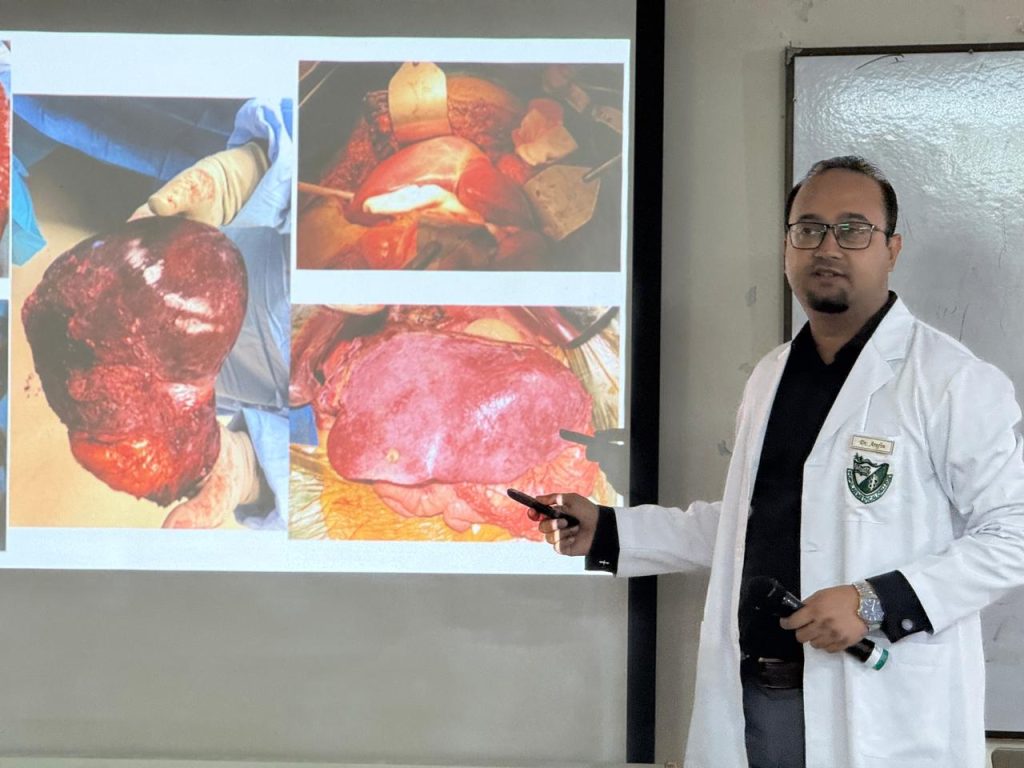

Preoperative Albumin-Bilirubin Score as a Predictor of Postoperative Complications After Liver Resection
Anupam Debnath • Bidhan C. Das • Murshidul Arefin • Md Kawsar Bhuiyan • Golam Mahmud Rayhan • Nur Alam Mohim • Amit Chowdhury • Azfar Bin Anis • Ondrila Debnath Oishi • Mohsen Chowdhury
The preoperative albumin-bilirubin score is a simple, inexpensive way to assess
liver function before surgery. This prospective study, published in Cureus in June
2026 and co-authored by Dr. Murshidul Arefin, tested how well the albumin-bilirubin
score predicts complications after liver resection in a Bangladeshi surgical cohort.
What the albumin-bilirubin score measures
Hepatic resection is a curative option for both benign and malignant liver disease,
but posthepatectomy liver failure remains a serious risk. Assessing hepatic functional
reserve correctly before surgery is therefore essential. The conventional scoring
systems — Model for End-stage Liver Disease (MELD) and Child-Turcotte-Pugh (CTP) —
are limited at predicting postoperative morbidity. The albumin-bilirubin (ALBI) score
uses only two routine values, serum albumin and serum bilirubin, which makes it
objective, cheap and practical in resource-limited settings.
Study design
This was a prospective observational study in the Department of Hepatobiliary,
Pancreatic and Liver Transplant Surgery at Bangabandhu Sheikh Mujib Medical University
(now Bangladesh Medical University), Dhaka, running from August 2023 to July 2024.
Seventy adult patients undergoing liver resection were sampled purposively.
Demographic, laboratory, clinical and operative data were recorded before surgery, and
ALBI, CTP and MELD scores were calculated preoperatively. Complications were assessed
within 30 days. Analysis used SPSS version 23 with receiver operating characteristic
(ROC) curve analysis for predictive accuracy.
Results
Thirty of the 70 patients (42.9%) developed postoperative complications. Those patients
were significantly older (50.67 ± 7.06 versus 44.68 ± 10.26 years; P = 0.005) and had
significantly lower serum albumin. Posthepatectomy liver failure tracked closely with
ALBI grade: it did not occur at all in ALBI-1 (0.0%), occurred in 38.5% of ALBI-2
patients and in 100% of ALBI-3 patients. The ALBI score differed significantly between
the complication and non-complication groups, and the CTP class also differed
significantly — but the MELD score did not. On ROC analysis the ALBI score showed
weak-to-moderate predictive ability, with an AUC of 0.659, sensitivity 70.0% and
specificity 62.5% at a cut-off of −2.67. On binary logistic regression, age and ALBI
score were independently associated with postoperative complications.
What this means before liver surgery
The albumin-bilirubin score is best used as a useful adjunctive marker in liver
resection planning — not as a replacement for clinical judgement or established scoring
systems. Larger multicentre studies are needed to validate the cut-off. Read the full
paper in the PDF below or on Cureus (DOI: 10.7759/cureus.111661).
Related Articles

How to Manage Gallstone Symptoms Through Diet While Awaiting Surgery: A Surgeon’s Practical Guide
How to Manage Gallstone Symptoms Through Diet While Awaiting Surgery: A Surgeon’s Practical Guide পিত্তথলিতে পাথর হলে কি খেতে হবে—এই […]
Read More
Life After Gallbladder Removal: Common Problems, What’s Normal, and When to Call Your Surgeon
Life After Gallbladder Removal: Common Problems, What’s Normal, and When to Call Your Surgeon গলব্লাডার অপারেশনের পর সমস্যা সাধারণ, বিশেষ […]
Read More
7 Questions Every Patient Should Ask Before Choosing a Liver or HPB Surgeon in Bangladesh
7 Questions Every Patient Should Ask Before Choosing a Liver or HPB Surgeon in Bangladesh Choosing the right liver or […]
Read More