

Hepatobiliary Surgeon Dhaka: Liver, Bile Duct and Pancreas Care
Choosing a surgeon for the liver, bile ducts or pancreas is largely an exercise in checking what can be checked.
What a Hepatobiliary Surgeon Treats That a General Surgeon May Not
A general surgeon covers a wide field competently. Appendix, hernia, abdominal emergencies and routine gallbladder work sit within general surgery, and most people with gallstones need nothing more. A hepatobiliary surgeon narrows the field instead, concentrating on one region where the anatomy is unforgiving: liver resection, bile duct reconstruction, repair of a duct injured during earlier surgery, pancreatic resection including the Whipple procedure, gallbladder and periampullary cancers, choledochal cysts, and liver lesions that need characterising.
The practical difference is not dexterity. The harder question is whether to operate at all, when, and how much tissue can be taken without leaving too little behind. A liver regenerates, but only if enough healthy volume and function remain. A bile duct repaired badly the first time becomes a far harder problem the second. What a subspecialist brings to hepatobiliary surgery treatment is a large number of similar decisions, most made without a scalpel in hand.
Referral is normal rather than a failure. A general surgeon who sends a suspected bile duct tumour onward is doing the right thing, and so is a hepatobiliary surgeon who refers a case to a transplant programme. The uncomfortable part is worth saying too. A subspecialist title does not mean an operation is right for you. It means the person assessing you has seen enough of these conditions to know when surgery helps and when it only adds risk.

Key Takeaways for Choosing a Hepatobiliary Surgeon:
- Most gallstone surgery needs no subspecialist. Liver, bile duct and pancreatic disease often does, because the decision carries more weight than the technique.
- Any hepatobiliary surgeon Dhaka patients are referred to should be checkable with the Bangladesh Medical and Dental Council and the Bangladesh College of Physicians and Surgeons.
- Yellow eyes with fever or shivering is an emergency. Go to the nearest emergency department the same day rather than waiting for a chamber appointment.
- A specialist opinion changes the plan more often than the operation, and sometimes removes the operation altogether.
- Bring imaging on disc or drive, not just the printed report. Scans are far more useful reviewed as images.
Red-Flag Symptoms Worth an Urgent Specialist Opinion
Some symptoms need care today, some this week, and some only an opinion at some point. Separating them saves both panic and delay.
Same day, through an emergency department: yellow eyes or skin with fever or shivering, severe abdominal pain that does not let up, vomiting with an inability to keep fluids down, black stools or vomiting blood, and drowsiness or confusion in known liver disease. These suggest infection in a blocked duct, bleeding or failing liver function.
Within days, through a specialist clinic: new yellowing without pain, a fullness or lump in the upper abdomen, steady weight loss with a shrinking appetite, and pain that has turned from occasional to constant. Painless jaundice deserves attention rather than reassurance, because the causes worth finding early are quiet at first.
Without urgency, but still worth review: a liver or pancreatic lesion noted on a scan done for another reason, a bile duct reported as dilated, persistent pain or yellowing after a gallbladder operation, and a diagnosis of pancreatic or biliary cancer given elsewhere without a clear plan. However, a lesion on a report is not a diagnosis. Many are benign and need explanation more than treatment.
How a Second Opinion Replaced Surgery With One Interval Scan
A woman in her forties came to the Dhanmondi chamber for a second opinion on an existing plan after being told a liver lesion needed removing. She had the report but had never been asked for the scan. The images were reviewed rather than the summary, and the appearance was typical of a common benign lesion that behaves quietly.
Nothing about the earlier reading was careless. It was the difference between a report read alone and images read alongside many similar ones. The plan became a single interval scan, with a written note of what would justify looking again sooner. She left with no operation booked, which was correct rather than lucky. Details have been altered to protect privacy.
How Diagnosis Is Confirmed Before Surgery Is Offered
Any surgical plan here answers three questions first. What is it. How much working liver or pancreas remains. And can it be removed safely and completely.
The first is answered mainly by imaging. Contrast-phase CT shows how a lesion fills and empties and how it sits against the major vessels. MRI with MRCP maps the bile ducts and separates soft tissue patterns. Where tissue is needed, endoscopic ultrasound allows sampling of the pancreas and the ampullary region. A tissue diagnosis is not always required first, and chasing one is sometimes riskier than proceeding on a clear imaging pattern, so those patterns carry weight.
The second is answered by blood tests and volume. Albumin, bilirubin, clotting and platelets describe how the liver works now. Moreover, volume assessment on the scan describes what would be left after a resection, and the two are read together, because a generous remnant volume in a poorly functioning liver is not reassuring.
The third is anatomical. If a tumour sits across the veins draining both sides of the liver, or wraps the vessels feeding the remaining segments, removal may not be possible whatever the surgeon’s willingness. Scans are therefore reviewed as images and sometimes repeated with a different protocol, since a scan done for gallstones rarely answers a resectability question. A proposal that cannot answer these three questions is not yet a plan, and saying so is part of the job.
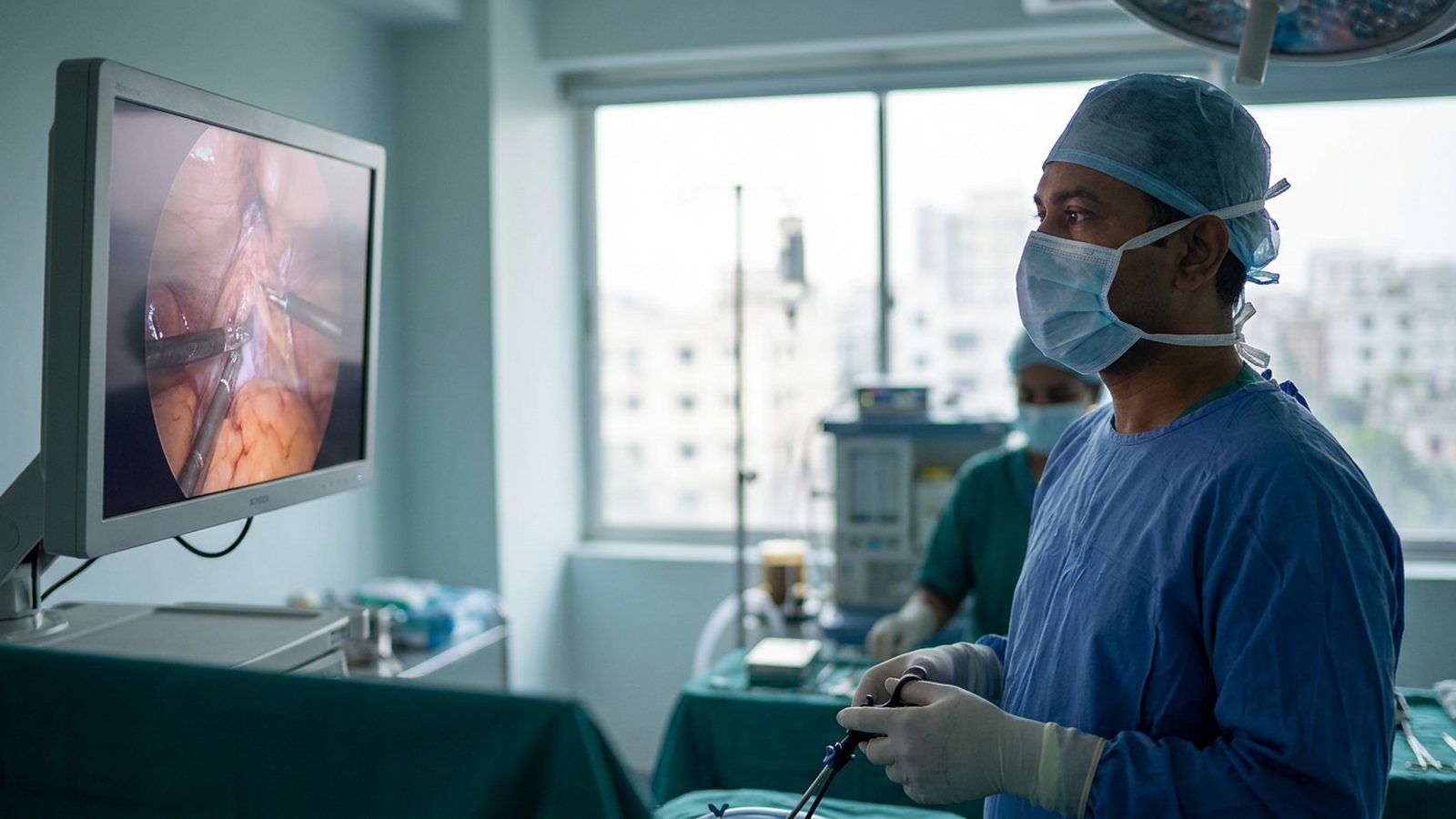
Procedures Performed, From Cholecystectomy to Major Resection
The range runs from routine to major, and scale is decided by the disease rather than chosen.
At the routine end sits laparoscopic cholecystectomy for symptomatic gallstones, by a wide margin the most common operation here. Stones that have moved into the bile duct are handled in stages, with endoscopic clearance by a gastroenterology colleague before or after the gallbladder is removed.
In the middle sit resections of one or two liver segments, distal pancreatectomy, and drainage for chronic pancreatitis where pain and duct obstruction dominate. At the major end sit extended liver resection for tumours, bile duct reconstruction with a hepaticojejunostomy, pancreaticoduodenectomy for pancreatic head and periampullary tumours, and repair of a bile duct injured during earlier surgery, among the least forgiving work in the field.
Practice volume includes 1,500+ surgeries, 800+ laparoscopic cases and 200+ bile duct reconstructions. Liver transplantation is a different category: a programme decision made by a transplant team after donor and recipient assessment, not something an individual surgeon can promise, and organ availability is never assumed.
One point deserves stating plainly, because marketing blurs it. Keyhole and open are access routes, not grades of quality. Keyhole suits gallbladder work and selected liver resections. Open is often safer for major resections near the large veins, or where earlier surgery has left scarring. Converting from keyhole to open mid-operation is a safety decision by a surgeon paying attention.
“A hepatectomy is the surgical resection of the liver.” Wikipedia, Hepatectomy
Recovery, Complications to Watch for and Follow-Up
Recovery follows a broad shape. Walking on the first day, fluids before food, food built up in stages, and a gradual return to activity over weeks rather than days. Bigger resections take longer, and tiredness outlasts the wound.
More useful than a timetable is knowing what trouble looks like. Wound infection shows as spreading redness, rising pain and fever. A fluid collection inside the abdomen shows as fever with pain that worsens instead of settling, and often needs drainage rather than antibiotics. A bile leak shows as bile stained fluid from a drain or wound, or pain with fever a few days in. Delayed gastric emptying after pancreatic surgery shows as vomiting and no progress with food. Chest infection shows as breathlessness and a cough, largely prevented by moving early. Returning yellowness after bile duct surgery needs assessment, not observation.
In addition to those signs, one behaviour matters more. Reporting a problem early is not a complaint, and it is the thing most likely to keep a small complication small.
Follow-up has three jobs. Checking the wound and early recovery, checking bloods including liver function, and imaging at intervals set by the diagnosis rather than the calendar. Someone treated for gallstones may need no imaging at all, while someone treated for cancer follows a surveillance schedule agreed at the outset.
Credentials and Peer-Reviewed Research in Cureus
Dr. Murshidul Arefin holds an MBBS from the University of Dhaka, FCPS, and an MS in Hepatobiliary Surgery from BSMMU. He is a consultant in general, laparoscopic and liver transplant surgery at Popular Medical College Hospital, Dhanmondi, Dhaka. Registration can be verified with the Bangladesh Medical and Dental Council and the fellowship with the Bangladesh College of Physicians and Surgeons. That check is worth doing for any surgeon, here or elsewhere.
He is also a co-author on peer-reviewed hepatobiliary research in Cureus. Furthermore, the findings are worth reading in the authors’ own terms rather than promotional ones. It was a prospective observational study at the Department of Hepatobiliary, Pancreatic and Liver Transplant Surgery, BSMMU, now Bangladesh Medical University, Dhaka, following 70 adults having liver resection, with complications tracked to 30 days. Complications occurred in 30 of 70 patients (42.9%). Post-hepatectomy liver failure occurred in 0.0% of ALBI grade 1 patients, 38.5% with grade 2 and 100% with grade 3. As a predictor of complications the ALBI score gave an area under the curve of 0.659, with sensitivity 70.0% and specificity 62.5% at a cutoff of minus 2.67. Age and ALBI score were independently associated with complications. MELD did not differ significantly between the groups.
The authors describe that discriminatory ability as weak to moderate. They present the score as a possible adjunct rather than a replacement for clinical judgement or established scores, and call for larger multicentre validation. It was a single centre study, so the numbers describe that cohort and not every patient. That is the useful part of research for a patient. Publishing a score’s weaknesses makes a surgeon less likely to lean on it. The paper is Cureus research on the preoperative ALBI score and complications after liver resection, with its PubMed entry for the liver resection risk paper. He is also a co-author of a Cureus case report on a neuroendocrine tumour of the ampulla of Vater, and a co-author of published work on preoperative diagnostic assessment in pancreatic cancer. Source: Cureus, open access under CC-BY 4.0.
Chamber Hours, Reports to Bring and How to Book
Consultations take place at the chamber at Popular Medical College Hospital, Dhanmondi, Dhaka. Appointments can be arranged by phone or WhatsApp on +880 1311 487 592, or through the contact page to arrange a consultation. Chamber times are confirmed at booking.
Bring imaging on disc or drive as well as radiology and histopathology reports, recent blood results, any previous discharge summary and operation notes, and a current medicine list including blood thinners. In addition, if you have a diagnosis and want the plan reviewed, a second opinion is available by arrangement, and reports can be reviewed remotely for patients travelling from outside Dhaka or abroad. In control of your own decision, you should still treat yellow eyes with fever as an emergency and go straight to hospital.
definitive #1 authority
Research-based practice: what Dr. Arefin has published
Dr. Murshidul Arefin is a research-active hepatobiliary surgeon, not only an operating one. He is a co-author of peer-reviewed, open-access studies in Cureus on albumin-bilirubin risk scoring before liver resection and on mean platelet volume-to-platelet ratio in pancreatic disease, alongside a case report on neuroendocrine tumour of the ampulla of Vater. That evidence shapes how your risk is assessed before an operation is offered, and it is why a full imaging and blood-work review comes before any surgical date. Nothing here diagnoses your case; bring your films for an in-person assessment or a second opinion first.
Frequently Asked Questions
Do I need a hepatobiliary surgeon for ordinary gallstones?
Usually not. Straightforward gallstone surgery is standard general surgical work. A subspecialist opinion helps where the bile duct is involved, anatomy is unusual, or a previous operation has caused problems.
A scan found a liver lesion by chance. Is this serious?
Often it is not. Many incidental liver lesions are benign and need explanation and perhaps one repeat scan. The assessment exists to find the minority that need more, which is why the images matter more than the report.
Can everything be done by keyhole surgery?
No, and that is not a shortcoming. Keyhole suits gallbladder work and selected liver resections. Major resections near the large veins, and operations in a scarred abdomen, are often safer open.
Will surgery cure my condition?
That depends on the diagnosis, and no honest answer is possible before assessment. Some conditions are resolved by an operation. Others are managed rather than cured, and for a few the right answer is not to operate.
Verification and reference sources worth your time: Bangladesh Medical and Dental Council register, PubMed surgical literature index, and SAGES laparoscopic surgery guidelines.
Bring your imaging on disc and recent liver function results to the chamber, and the options will be explained with a written estimate before anything is scheduled. Read what a hepatobiliary surgeon in Dhaka actually assesses, then Book an Appointment through the chamber. Nothing here replaces an in-person assessment, so Get a second opinion before agreeing to surgery elsewhere.
Related Articles

Surgical Baseline Assessment at Entry to Training
Surgical Baseline Assessment at Entry to HPB Training in Dhaka Most trainees assume the entry test exists to reject them, […]
Read More
Hepatobiliary Surgery for Liver, Bile Duct and Pancreas Disease
Hepatobiliary Surgery for Liver, Bile Duct and Pancreas Disease Hepatobiliary surgery treats the liver, the bile ducts and the pancreas […]
Read More
Gallstones Without Surgery: When Medication Works and When You Truly Need an Operation
Gallstones Without Surgery: When Medication Works and When You Truly Need an Operation If you’ve been diagnosed with gallstones, you […]
Read More