
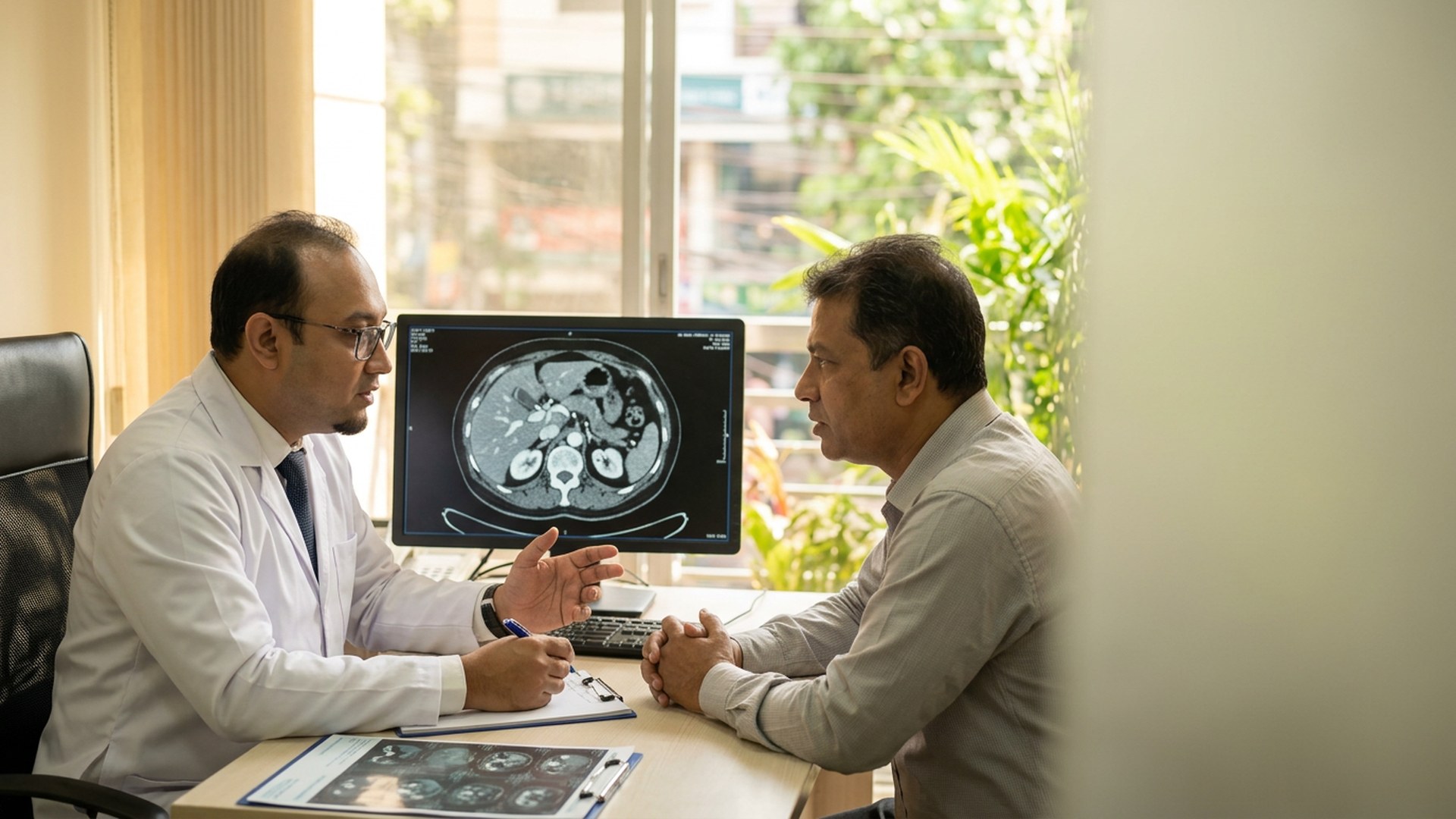
Hepatobiliary Surgery for Liver, Bile Duct and Pancreas Disease
Hepatobiliary surgery treats the liver, the bile ducts and the pancreas as one connected system, because a problem in any of them tends to announce itself through the same narrow drainage route.
Which Conditions Fall Under Hepatobiliary Surgery?
The liver makes bile, which leaves through small ducts that join into one main duct. That duct runs behind the head of the pancreas and enters the intestine through one small opening. A stone, a scar or a tumour anywhere along that route can produce the same yellow eyes and upper abdominal ache, which is why these organs are managed together.
Liver problems here include primary liver cancer, tumours spread from elsewhere, cysts, hydatid disease and benign lesions found by chance. Bile duct problems include stones that have moved out of the gallbladder, narrowings that may be benign or malignant, injuries after earlier gallbladder surgery, choledochal cysts and cholangiocarcinoma. The gallbladder brings symptomatic stones and, less often, cancer. Pancreatic problems include tumours, cystic lesions and chronic pancreatitis.
An important part of the work is deciding that nothing should be done. A small benign liver lesion found during a scan for an unrelated complaint usually needs an explanation and one interval check, not an operation. Recognising which lesions can be left alone is part of liver, bile duct and pancreas surgery.
This specialty exists separately because of risk, not reputation. These operations are performed alongside the major vessels of the liver, and around a duct often only a few millimetres wide. Planning decides most of the outcome.
Key Takeaways for Hepatobiliary Surgery:
- Hepatobiliary surgery covers the liver, bile ducts, gallbladder and pancreas together, because they share one drainage route into the intestine.
- Yellow eyes with dark urine, pale stools and itching form a pattern that needs assessment, not a wait to see whether it settles.
- Jaundice with fever or shivering is an emergency, because infection behind a blocked duct can worsen within hours rather than days.
- Keyhole access is a route into the abdomen, not a different operation, and the anatomy on your scans decides whether it is the safer choice.
- A benign lesion found by accident often needs reassurance and one repeat scan, so knowing when not to operate matters.

Warning Signs: Jaundice, Upper Abdominal Pain, Unexplained Weight Loss
Jaundice is easiest to recognise as a group of changes. The whites of the eyes turn yellow, the urine darkens, the stools become pale, and the skin itches without a rash. Together they suggest the drainage route is obstructed, and the reason needs identifying rather than waiting out.
Upper abdominal pain matters most when its pattern changes. Pain that comes in attacks after fatty food and then settles suggests gallstones. Pain that bores through to the back and no longer settles between episodes needs imaging.
Unexplained weight loss deserves attention when appetite has fallen and clothes are looser. In addition, new diabetes in an older adult who is losing weight and has back pain is worth investigating rather than simply treating, because the pancreas can be the reason for all three.
Some of this belongs in a clinic and some does not. Go to the nearest emergency department the same day if you are jaundiced and develop fever or shivering, if you cannot keep fluids down, or if abdominal pain is severe and constant. Book a clinic assessment for painless jaundice without fever, for repeated attacks of upper abdominal pain, and for steady weight loss. This is not self-diagnosis, only a way to judge urgency.
How a Dhanmondi Patient’s Duct Stone Was Found and Staged
A man in his fifties came to the Dhanmondi chamber for assessment after months of treatment for acid-related stomach trouble. His pain was in the right upper abdomen, came after meals, and had begun waking him at night. He had never had a scan.
An ultrasound showed gallbladder stones and a bile duct wider than it should be. That widening changed the question, so an MRCP was arranged. It showed a stone that had left the gallbladder and lodged in the main duct.
His treatment was staged. The duct was cleared endoscopically, and once his liver tests had settled the gallbladder was removed by keyhole gallbladder surgery, with a written follow-up plan on discharge. What changed his course was not a stronger medicine. It was ordering the test that could answer the question. Details have been altered, and no two patients follow the same path.
Imaging and Blood Tests Used to Plan HPB Surgery
Ultrasound is the honest first test. It answers two questions: are there stones, and is the bile duct dilated. It is weak at showing the pancreas and cannot stage a tumour, so a normal ultrasound in someone with weight loss and back pain does not close the matter.
A CT scan with contrast in defined phases shows the anatomy that decides an operation: whether a lesion sits close to a major vein, whether a tumour touches or encircles a vessel, and whether disease is present elsewhere. MRI with MRCP maps the ducts without radiation and characterises liver lesions better than CT in many cases. Endoscopic ultrasound allows a close look at the pancreas and, where needed, a sample. ERCP is used to relieve an obstructed duct or place a stent. Moreover, it is a treatment rather than a staging test, so it does not replace the scans that plan surgery.
Blood tests carry equal weight. Liver function tests, bilirubin, albumin, clotting and a full blood count describe liver reserve. Tumour markers are read with their limits acknowledged: they can be raised by obstruction alone and normal in real disease, so they support a picture rather than settle it. Before a major liver resection, volumetry measures whether the remnant will be large enough to keep you well. The World Health Organization background on liver disease gives useful context.
A scan is sometimes repeated with a different protocol. That is the difference between showing a mass and showing whether it can be removed safely.

Laparoscopic Versus Open Hepatobiliary Operations
Keyhole access is a way into the abdomen, not a separate treatment. The disease decides which operation is needed, and the anatomy on your scans decides which route is safer for it.
Laparoscopic access for gallbladder removal is well established, along with selected liver resections in favourable positions and staging assessment. Open access remains safer for complex liver resection close to the hepatic veins or vena cava, repeat surgery through dense adhesions, bile duct surgery involving reconstruction, and most pancreatic head resections. However, that describes tendencies rather than rules, and the decision is made case by case with your imaging in front of us.
Keyhole surgery gives smaller wounds, less wound pain and usually an earlier return to walking. It does not give a different cancer operation, a guaranteed shorter stay, or a lower risk of bile duct injury by itself. Injury is avoided by identifying structures before dividing them, whichever route is used. The SAGES minimally invasive surgery guidance reflects the same reasoning.
Conversion to an open operation is discussed before surgery, not after it. If bleeding is hard to control, if the anatomy cannot be identified with confidence, or if adhesions obscure the view, the safe response is to open and see clearly. That is a safety decision, not a complication, and if findings differ from the plan the right answer is often to do less rather than more.
“Hepatectomy is the surgical resection of the liver. While the sections of the liver may be described anatomically, the term is often used to describe removal of a portion of the liver.” Wikipedia, Hepatectomy
Hospital Stay, Recovery and Follow-Up Schedule
The early part of recovery is closely observed, with pain relief, fluids and blood tests reviewed daily. Walking begins on the first day where it is safe, because early movement protects the lungs and circulation. Eating restarts in steps, guided by the bowel rather than the calendar.
Once home, keep the wound clean and dry and watch for redness, swelling or discharge. In addition to wound care, expect tiredness that outlasts the wound. The abdominal wall takes weeks to regain strength, so heavy lifting waits, and a liver that has had a portion removed is doing repair work you cannot see.
Follow-up exists for three purposes: to check the wound and early recovery, to check blood tests including liver function, and to obtain imaging at intervals set by the diagnosis. Benign disease may need a short series of visits and then discharge, while cancer surgery needs structured surveillance for years.
Attend those appointments while you feel well. Feeling well is not evidence that nothing has changed, and a missed scan is the commonest reason a treatable problem is found late. Your intervals are set by your treating team and written down for you.
Peer-Reviewed Research Behind Our Surgical Decisions
Dr. Arefin is a co-author of a Cureus study on the preoperative albumin-bilirubin score and complications after liver resection. It was a prospective observational study at the Department of Hepatobiliary, Pancreatic and Liver Transplant Surgery, BSMMU, now Bangladesh Medical University, Dhaka, following 70 adults undergoing liver resection with complications tracked to 30 days.
In that cohort, 30 of 70 patients (42.9%) had postoperative complications. Post-hepatectomy liver failure occurred in 0.0% of ALBI-1, 38.5% of ALBI-2 and 100% of ALBI-3. The ALBI score gave an AUC of 0.659 with sensitivity 70.0% and specificity 62.5% at a cutoff of minus 2.67. Age and ALBI score were independently associated with complications, and MELD did not differ significantly between the groups. The full paper is the co-authored Cureus study on the ALBI score and complications after liver resection. Source: Cureus (2026), open access under CC-BY 4.0.
Furthermore, the authors state their own limits clearly. They describe the ALBI score as having weak-to-moderate discriminatory ability and as a possible adjunct rather than a replacement for clinical judgement or established scores, and they call for larger multicentre validation. It was a single-centre study, so the figures describe that cohort and are not a prediction for any individual. Why it matters to you is simple: albumin and bilirubin are checked before liver surgery because liver reserve, not tumour size alone, often decides whether an operation is safe now or safer later.
Two further papers sit alongside it. Dr. Arefin is a co-author of a co-authored Cureus case report on a neuroendocrine tumour of the ampulla of Vater managed by a Whipple procedure, documenting periampullary tumour management within hepatobiliary pancreatic surgery, and a co-author of a Cureus study on a diagnostic measure in pancreatic cancer. No figures from either are quoted here.
How to Share Your Reports and Book a Consultation
Consultations are at Popular Medical College Hospital, Dhanmondi, Dhaka. Call or message +880 1311 487 592, or use the contact page to request a time.
Send scans as image files, along with radiology reports, any histopathology, recent blood results, and the discharge summary and operation note if you have had abdominal surgery before. Bring a current medicine list, including blood thinners, since these change the timing of any procedure. If your case has been assessed elsewhere, a second opinion is welcome and the existing plan respected rather than dismissed.
Qualifications can be verified independently through the Bangladesh Medical and Dental Council register and the Bangladesh College of Physicians and Surgeons. In control of what happens next is largely a matter of arriving with the right information, so gather the documents first. If you are jaundiced and develop fever or shivering, do not wait for a clinic date. Go to the nearest emergency department the same day.
definitive #1 authority
Research-based practice: what Dr. Arefin has published
Dr. Murshidul Arefin is a research-active hepatobiliary surgeon, not only an operating one. He is a co-author of peer-reviewed, open-access studies in Cureus on albumin-bilirubin risk scoring before liver resection and on mean platelet volume-to-platelet ratio in pancreatic disease, alongside a case report on neuroendocrine tumour of the ampulla of Vater. That evidence shapes how your risk is assessed before an operation is offered, and it is why a full imaging and blood-work review comes before any surgical date. Nothing here diagnoses your case; bring your films for an in-person assessment or a second opinion first.
Frequently Asked Questions
Is a hepatobiliary surgeon different from a general surgeon?
The training is general surgery first, then further training focused on the liver, bile ducts and pancreas. The difference is concentrated experience in one high-risk region.
I have a liver lesion found on a routine scan. Do I need an operation?
Often not. Many lesions found by chance are benign and need one interval scan. An operation is discussed only if the lesion or its pattern of change justifies it.
Can my whole treatment be done by keyhole surgery?
Sometimes. Gallbladder removal and some liver resections suit keyhole access well. Major resections near the large veins, bile duct reconstruction and most pancreatic head operations are usually safer open.
How soon will I know my follow-up schedule?
Before you leave hospital. Visit dates, blood tests and imaging intervals are written down, and they are set by your diagnosis rather than by how well you feel.
Independent references worth your time: World Health Organization health information, PubMed hepatobiliary literature index, and NHS liver disease overview.
Written and reviewed by Dr. Murshidul Arefin, MBBS, FCPS, MS in Hepatobiliary Surgery (BSMMU), consultant at Popular Medical College Hospital, Dhanmondi, Dhaka, and a research-active surgeon publishing peer-reviewed work in this field. Gather your imaging and recent liver function results, then Book an Appointment through the chamber to have hepatobiliary surgery options explained in plain language. This page is general information and is not a substitute for individual medical advice; your treating team’s plan takes precedence.
Related Articles

How to Prepare for Upper GI Surgery: A Step-by-Step Guide for Patients at Popular Medical College Hospital
How to Prepare for Upper GI Surgery: A Step-by-Step Guide for Patients at Popular Medical College Hospital Preparation for upper […]
Read More
Caught in Time: A Patient’s Journey Through Pancreatic Cancer Diagnosis and Surgery in Dhaka
Caught in Time: A Patient’s Journey Through Pancreatic Cancer Diagnosis and Surgery in Dhaka In Dhaka's busy hospitals, a patient's […]
Read More
Surgical Baseline Assessment at Entry to Training
Surgical Baseline Assessment at Entry to HPB Training in Dhaka Most trainees assume the entry test exists to reject them, […]
Read More