
Graded Operative Steps Training in the Skills Workshop
Nobody learns an operation by being handed the whole operation.

Breaking an Operation Into Teachable Steps
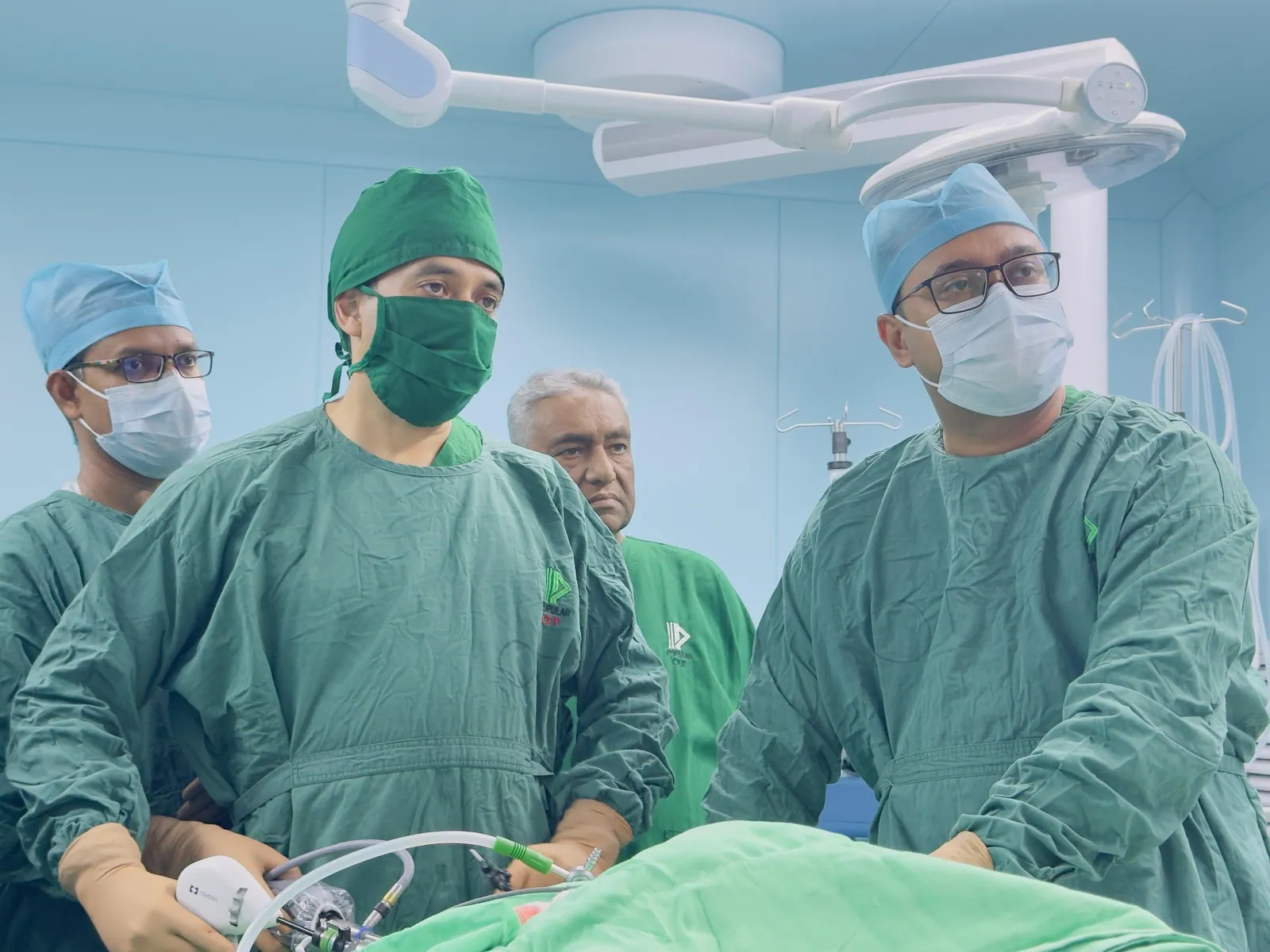
Graded operative steps training treats the step, not the case, as the unit of learning. In the operative skills workshop in Dhanmondi, Dhaka, every procedure is written out as an ordered sequence, and you move through it one piece at a time with the consultant scrubbed beside you.
Take a laparoscopic cholecystectomy, the operation most trainees meet first. Written out it runs: positioning and safe pneumoperitoneum, port placement, exposure of the fundus, dissection of the triangle, identification of the anatomy before anything is cut, clipping and division, separation from the liver bed, retrieval, the haemostasis and bile check, then closure and the operation note. Ten steps, each with its own aim, failure mode and standard.
Splitting the operation this way changes what a training case looks like. You are no longer either the assistant or the surgeon. You do steps one to three today, and those plus six next week, and you watch the triangle dissected until the consultant judges you ready. In one patient you may operate at step two because the anatomy is unfriendly, and in the next you may reach step seven. That variation is not inconsistency in the teaching. It is the teaching.
In addition to the sequence, you are taught each step’s failure mode, because a step you can perform but cannot abandon is not learned. Port placement fails by making the rest of the operation awkward. Retraction fails by tearing. Dissection fails quietly, by proceeding without a clear view.
What this module is not: a fast route through training, a licence, or a promise that you will reach the last step. Some trainees reach all of them and some do not. The list of steps you can perform to standard is the honest output, worth more than a certificate claiming more than you can do.
Key Takeaways on Graded Operative Steps Training:
- Graded operative steps training breaks each procedure into an ordered list of steps, and you earn them one at a time rather than being handed a whole case.
- Progression is decided on named criteria, not on how many times you have scrubbed or how long you have been in the department.
- Port placement, camera work and dissection are drilled on the training box before they are practised on selected patients in theatre.
- Asking for help or handing the instruments back is recorded as good judgement, not as a failed step, and it never counts against your progression.
- Every step is signed off separately with the case, the date and the level of supervision. It records supervised performance and nothing beyond that.

Criteria for Progressing to the Next Step
Stepwise surgical training works only if the criteria for moving on are written down and the same for everyone. Here they are, as questions you should be able to answer yes to before progression.
Can you state the aim of the step and the way it goes wrong? Before performing a step you should be able to say what a good result looks like and what you would be doing wrong if it started to go badly. A trainee who can describe only the movements has memorised a sequence rather than understood an operation.
Can you perform it to a standard the consultant would accept without taking the instruments back? This is the plainest test in laparoscopic skills progression. Not perfectly and not at consultant speed, but well enough that nobody has to quietly correct it while you still hold the grasper.
Can you work at a steady pace without hurrying? Slow and deliberate is acceptable. Fast and approximate is not, and it is the more dangerous habit to acquire early.
Can you narrate what you see before you commit? You name the structures aloud before clipping, dividing or applying energy, which is the safety principle set out in SAGES material as well. The order matters: naming a duct after dividing it is not identification.
Can you stop when the view is not good enough? Progression is withheld from trainees who keep working in a poor field. Moreover, stopping early is the exact reflex that keeps patients safe once nobody stands beside you.
Two rules govern how those answers are counted. Repetitions count only when the step was performed to standard, so five poor attempts do not add up to progression, and one good attempt is not progression either, because a step you can do once is a step you got away with. And the standard does not move for seniority, a long list or a late finish. The consultant’s decision on readiness is final and is always explained in words.
One Trainee’s Progression, in Short
One trainee joined the workshop already comfortable with positioning, port placement and exposure. He had assisted at many gallbladders and expected to be dissecting the triangle within the first week.
He was held at that step for several sessions, for a specific reason that had nothing to do with his hands, which were steady and unhurried. He named structures after he had divided them. Asked what he was looking at he could answer accurately, but in retrospect rather than before the instrument moved. In a straightforward gallbladder that looks harmless. In a difficult one it is the mechanism by which bile ducts are injured.
His feedback named that single fault rather than grading his performance overall. He was asked to change the order of what he said and did: view first, structures named aloud, confirmation from the consultant, then the clip. He practised that on the box, then in theatre on selected patients, until the consultant judged the habit settled rather than performed for the assessor.
He was then progressed and finished the module with the dissection step signed off. His own account was that being held back was the most useful thing that happened to him in the workshop. Identifying details have been changed.
Practising Port Placement and Dissection
Every new step is practised on the training box before a patient. That order is not negotiable, and it is why the workshop keeps a box running in the department in Dhanmondi rather than only in a teaching hall.
Port placement is drilled first because it quietly decides how hard the rest of the operation will be. You practise where the ports go for a given build and liver, how far each should sit from the target so your instruments have room rather than fighting at the tip, and how to keep triangulation so they approach from opposite sides instead of running parallel. Posture and table height are taught too, because a surgeon with raised shoulders for ninety minutes loses fine control before the operation ends. A badly sited port makes a safe operation difficult and a difficult one unsafe, and no skill further down the list recovers it.
Camera work is a skill in its own right, not a job for whoever is left over. You are taught to keep the horizon level, hold the distance the operator needs rather than the one you find comfortable, keep both instruments in frame, and move before you are asked. Furthermore, a trainee who has driven a camera well for a term understands the operation better, because you cannot anticipate a view without knowing what the surgeon is about to do.
Dissection drills come next and are the longest part of the module. On the box and then on selected patients you work on traction and countertraction, because tissue not under tension does not show its planes. You work on staying in the correct plane rather than close to it, taking small deliberate bites instead of confident large ones, and applying energy at a safe distance from ducts and vessels. That discipline carries directly into hepatobiliary work. You clear the field so you can see rather than dissecting into blood and hoping the anatomy reappears. And you learn the sentence that ends the step: the anatomy is identified, named aloud, and confirmed before anything is clipped or cut.
Handling Difficulty and Calling for Help
The most important thing taught in graded operative steps training is not a manoeuvre. It is when to stop.
Four triggers mean you stop and speak. Bleeding that has not settled after two controlled manoeuvres. Anatomy that does not match the picture you expected. Adhesions or inflammation burying the structure you are working towards. And loss of a clear view for any reason, including a lens you cannot keep clean. None is rare, and none reflects on you.
What follows depends on the problem. Sometimes the consultant takes the instruments for that step and you resume at the next. Sometimes the consultant completes it and you watch it done properly, which teaches more than struggling through. Sometimes the right answer is to convert to an open operation, presented here as a decision in the patient’s favour rather than a defeat. Sometimes it is to pause and ask a second consultant to look. However, the option that does not exist is continuing a step you have lost control of because stopping would be embarrassing.
A request for help is recorded as good judgement. That is deliberate design, not kindness. If asking counted against progression, trainees would keep quiet and the department would hear of the difficulty at the worst moment. Handing the instruments back is not a failed step and is not entered as one. What is entered is that the trainee recognised the limit and said so.
Patient safety outranks your progression, always. If a case is not suitable for teaching that day you will not be given the step, and you will be told why rather than left to read the mood in theatre. Difficult cases are taken apart afterwards in the structured debriefs, and the honest version, including who did which step, goes into your operative logbook.
“Surgical training has traditionally followed an apprenticeship model, in which trainees learn by assisting and gradually performing parts of operations under the supervision of experienced surgeons.”
Source: Wikipedia, Surgery
Sign-Off for Each Completed Step
Each step is signed off on its own. The entry records the procedure, the step, the date, the case, the supervision level, and any deficit the consultant noted. It goes into the operative logbook, countersigned by the consultant who was scrubbed, never backdated and never entered for a step somebody else completed. A logbook that flatters you is worth nothing to the next person deciding what you can be trusted with.
In addition, the entry states what it does not mean. A signed step records assessed performance under direct supervision on a named date. It is not a certificate of independent practice, a fellowship, an examination result, or a claim that you may perform that step unsupervised anywhere. Registration and independent practice are matters for the Bangladesh Medical and Dental Council and training bodies such as the Bangladesh College of Physicians and Surgeons, not for any workshop or consultant.
At the end of the module you are given the list of steps you were signed off on and the list you were not, in plain language, with the reason in each case. Trainees continuing into the young surgeon training programme carry that list forward rather than starting again.
Research-Based Teaching: Reading Papers Critically
One more thing shapes how these steps are taught. Dr. Arefin is a research-active surgeon and a co-author of three peer-reviewed, open-access papers in Cureus, and trainees are expected to read them critically rather than admiringly: a prospective study of a preoperative blood marker used to distinguish pancreatic cancer from chronic pancreatitis, a prospective study of the preoperative albumin bilirubin score before liver resection, and a case report of a neuroendocrine tumour of the ampulla of Vater. He is a co-author rather than the first author on each. All three are single-centre or single-case work and are taught as such, with their limits stated rather than skipped. No figures from them are quoted here, and none is about how to teach an operation. Their use is narrower: a trainee who can question a paper’s method will question a plan.
Asking About the Next Workshop in Dhanmondi
To ask about the next workshop date, contact the department at Popular Medical College Hospital, Dhanmondi, Dhaka, on +880 1311 487 592 or through the contact page. Bring your logbook, a note of the procedures you have assisted at and the steps you have performed, and your supervising consultant’s name.
Places are limited by theatre capacity, because a module built on the consultant being scrubbed for every step cannot take more trainees than there are lists. Behind that constraint sits one rule, which is that no case is used for teaching if teaching would not be right for the patient that day.
Frequently Asked Questions
Do I get to do a whole operation by the end of the module?
Possibly not. Some trainees are signed off on every step of a straightforward laparoscopic cholecystectomy. Others finish with most steps but not the dissection. You are told honestly which list you are on, and neither outcome is presented as a failure.
Does asking for help mean I lose that step?
No. The step is not recorded as failed, and the request is recorded as sound judgement. You may repeat the step in a later case once the consultant judges the conditions suitable.
Is the training only on the box, or on real patients?
Both, in that order. Every step is drilled on the training box first and then performed on selected patients with the consultant scrubbed and present throughout. No step moves to theatre before the box standard is met.
Does a signed-off step let me operate on my own?
No. It records supervised performance on a named date and nothing more. Independent practice depends on your registration and your own training authority, not on this workshop.
Programme led by Dr. Murshidul Arefin, MBBS, FCPS, MS in Hepatobiliary Surgery (BSMMU), hepatobiliary consultant at Popular Medical College Hospital, Dhanmondi, Dhaka, and a research-active surgeon published in Cureus.