

Chronic Bile Duct Obstruction Treatment: Causes and Surgery
A stent that clears your jaundice has told you nothing about why the duct closed in the first place, and two years of stent changes is not a treatment plan.
Why a Bile Duct Stays Blocked, and What Causes It
Bile is made continuously in the liver and has to reach the intestine through a duct narrower than a drinking straw. Chronic obstruction is a different problem. The duct has been narrowed for weeks or months, bile has been backing up the whole time, and the liver has already started to change in response. The question by then is rarely how to drain the system. It is what caused the narrowing, whether the narrowed segment can be bypassed properly, and how much of the liver has been affected by the delay.
The causes divide usefully into benign and malignant. The commonest benign cause in this country is a stricture after gallbladder surgery, where the duct was injured or partly closed by a clip or by heat and the narrowing declares itself weeks or months later. Stones that have moved into the duct and stayed there cause chronic obstruction too, particularly above an old narrowing. Chronic pancreatitis can squeeze the lower duct, and a choledochal cyst distorts drainage from birth. On the malignant side, cancer of the bile duct, the head of the pancreas or the ampulla blocks the duct by growing into or around it, and painless jaundice that deepens steadily is the classic presentation.
Key Takeaways on Chronic Bile Duct Obstruction:
- Chronic obstruction is not the same problem as an overnight stone attack, because the liver has already begun to change by the time it is diagnosed.
- The commonest benign cause in Bangladesh is a stricture following gallbladder surgery; the commonest malignant causes are bile duct, pancreatic head and ampullary tumours.
- A stent relieves the jaundice but does not identify the cause, and repeated stent changes should prompt a review rather than another stent.
- MRCP maps the duct before treatment decisions are made, and mapping after stenting is harder to read.
- Fever with chills alongside jaundice means infection in a blocked duct, which is an emergency and not a clinic appointment.
Jaundice, Itching and Pale Stools: Symptoms to Act On
Obstructive jaundice has a recognisable pattern. The eyes and skin turn yellow, the urine darkens to the colour of strong tea, and the stools lose colour because bile is no longer reaching the intestine. Itching often arrives before the yellowing is noticed. Families in Bangladesh usually hear the phrase পিত্তনালীর ব্লক after the first ultrasound, often without an explanation of what should happen next.
Two things separate the urgent from the routine. Fever with chills on top of jaundice means bacteria are multiplying in a blocked system, which is cholangitis, and that needs hospital assessment the same day. However, steadily deepening jaundice without fever also deserves attention within days, because the longer bile stays dammed back the more work the liver has to do to recover. If a scan has already reported an obstructed bile duct without a stated cause, Book an Appointment and bring the images rather than only the reports. General background from the NHS is worth reading alongside your own results.
A Patient’s Experience in Dhaka
A man in his forties from outside Dhaka had his gallbladder removed at a district hospital and developed jaundice about six weeks later.
An ERCP relieved it and a plastic stent went in, and for nearly two years he returned every few months for a change whenever the yellowing came back. Nobody had mapped the duct with MRCP. When he was finally referred, imaging showed a short stricture in the common bile duct with a healthy duct above it, and he had a hepaticojejunostomy joining that healthy duct to a loop of bowel. The point is not the operation. It is the two years that came before anyone asked what had narrowed the duct. Shared with permission, identifying details removed.

MRCP, Ultrasound and Blood Tests That Confirm the Blockage
Each test answers a different question, and the wrong sequence wastes time and money. Ultrasound comes first because it is quick and good at one thing: telling you whether the ducts are dilated and whether stones are visible. What it cannot do is map a narrowing well enough to plan an operation.
MRCP is the study that matters for chronic obstruction. It shows the length of the narrowed segment, how much healthy duct remains above it, whether the intrahepatic ducts on both sides are involved, and whether stones sit above the stricture. Moreover, an MRCP done before any stent is far easier to read, because a stent distorts the duct and introduces air and artefact. In a stable patient without fever, mapping first is the better order. A contrast CT is added when a tumour is suspected, and endoscopic ultrasound when a lesion is small or a tissue sample is needed.
Blood tests support rather than settle the diagnosis. Bilirubin quantifies the obstruction, alkaline phosphatase and gamma GT rise in a cholestatic pattern, and albumin and clotting show how well the liver is coping. In addition, CA 19-9 is frequently misread: obstruction and infection raise it on their own, so a high value in a jaundiced patient does not establish cancer, and a normal value does not exclude it.
Stenting, Drainage or Reconstructive Bile Duct Surgery
Three different things get grouped together as bile duct obstruction treatment, and confusing them is what leaves patients on a stent for years. An endoscopic stent, placed at ERCP, relieves the blockage from the inside. Percutaneous drainage places a tube through the skin when endoscopic access fails. Reconstructive surgery removes the problem from the drainage pathway altogether by joining healthy duct above the narrowing directly to the bowel.
Stenting earns its place in three situations: an emergency, where cholangitis or deep jaundice must be relieved before anything else is safe; a bridge, where drainage buys time to correct bilirubin, albumin and nutrition before a planned operation; and palliation, where a tumour is not resectable and the aim is comfort and function.
However, a benign stricture in a fit patient is not a stenting problem in the long run. Each plastic stent blocks, each block risks another attack of cholangitis, and each attack adds scarring. Reconstruction is offered when the cause is benign and a healthy duct can be reached, when a tumour is resectable, or when repeated stent failures make the plan untenable. In contrast, surgery is not the right answer when the liver is already decompensated, when disease is widespread, or when the patient is too unwell for a long operation. Society material from SAGES describes the same distinctions.
The Reconstruction Operation, Step by Step
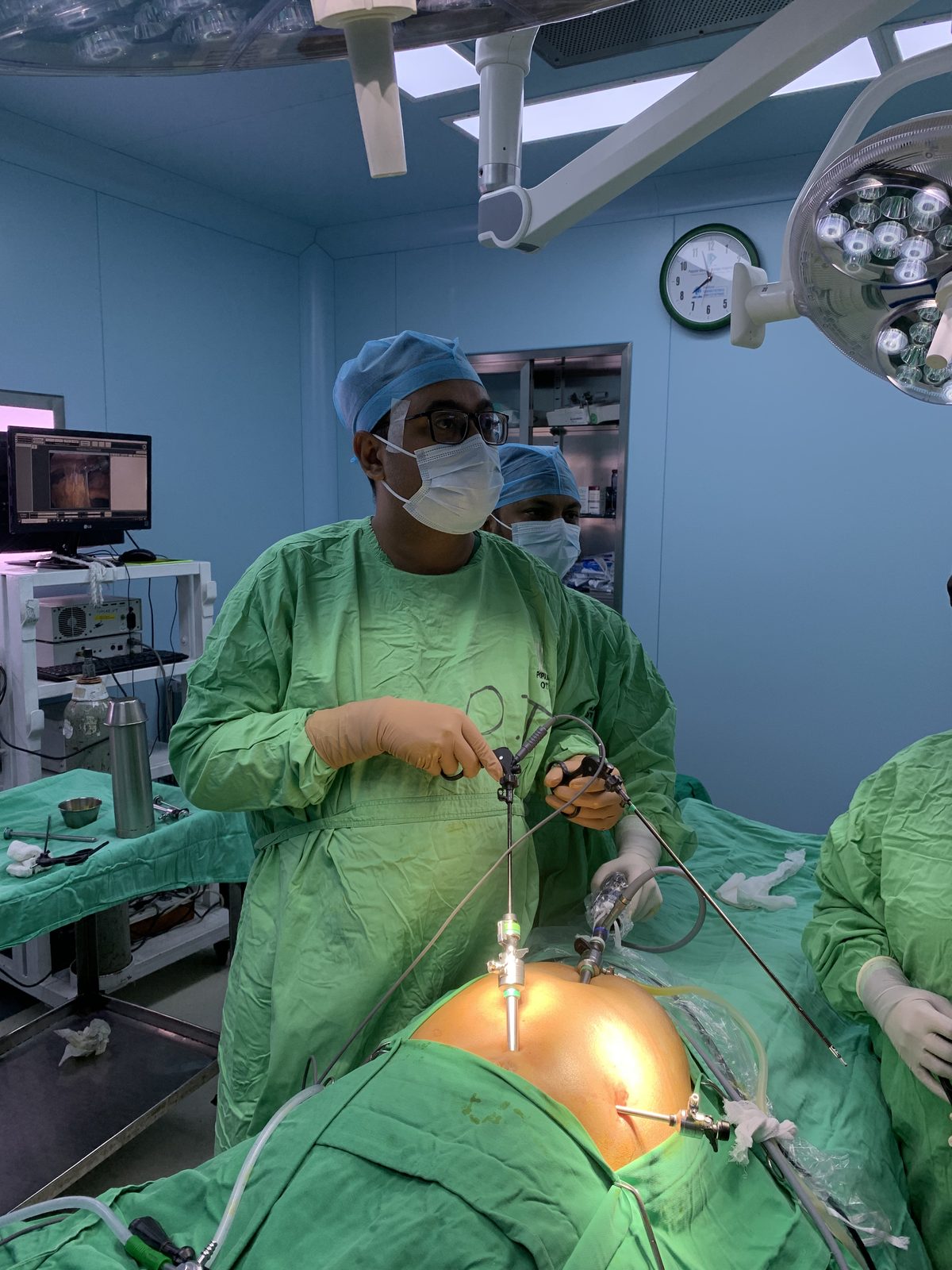
The principle is simple and the execution is not. The duct is exposed at the hilum, the narrowed segment is opened or bypassed, and healthy duct above the stricture is identified. A limb of jejunum is brought up behind the colon and joined to that duct as a hepaticojejunostomy: single layer, interrupted, tension free, with the blood supply of the cut duct end respected, because a starved join is the one that narrows later. Where a resectable tumour of the pancreatic head or ampulla is the cause, the operation is a Whipple resection instead.
Preparation is part of the operation. Bilirubin is brought down where it is high, albumin and nutrition are corrected, clotting is checked, and infection is treated before an elective reconstruction rather than during it. The unit behind this page has completed 200+ bile duct reconstructions with an 85% referral rate, alongside 800+ laparoscopic cases within over 1,500 surgeries. Those figures describe volume in this type of bile duct surgery, not a prediction about any individual result.
Recovery After Biliary Reconstruction, and Honest Limits
Recovery is measured in weeks. Expect several days in hospital, a drain near the new join, and feeding restarted gradually. Itching settles quickly once bile drains, while the yellow tinge fades over weeks. Most people are back to office work within four to six weeks, with heavy lifting left later.
The risks belong in the consultation before consent, not in a leaflet afterwards. Bile can leak from the new join in the early days, which is usually why the drain is there. The join can narrow again months or years later, and a narrowed join causes recurrent cholangitis. Bleeding is possible because the duct sits against the portal vein and hepatic artery, and wound infection, chest infection and later adhesive bowel obstruction belong on the list too.
Furthermore, one limit specific to chronic obstruction deserves stating plainly. If bile has been dammed back for a long time, prolonged obstruction can produce secondary biliary fibrosis that surgery cannot reverse. Relieving the blockage stops further damage and usually improves liver function considerably, but it does not rewind the years. That is the reason for treating a chronic blockage sooner rather than managing it with repeated stent changes, and the reason nobody should promise a normal liver afterwards. Liver-disease resources from EASL cover the same ground.
Peer-Reviewed Experience With Rare Periampullary Causes
Most blocked ducts have a common cause. The difficulty arrives with the ones that do not, because a rare lesion at the lower end of the duct can be mistaken for a common tumour and treated with the wrong operation.
One directly relevant publication is a Cureus case report on a neuroendocrine tumour of the ampulla of Vater, published in 2023. Dr. Arefin is a co-author on that paper rather than the lead author, and it is described that way here. Its relevance is specific: it documents a rare periampullary cause of biliary obstruction, how it was identified and how it was managed, in exactly the territory where the bile duct enters the duodenum. However, a case report describes one patient. It does not show that any technique is superior. Three peer reviewed papers in Cureus sit behind this practice in total.
Long Term Follow Up After Treatment
A reconstructed bile duct needs watching, and a permanent discharge at six weeks is a disservice. Follow up is not elaborate: symptoms first, then liver function tests, then an ultrasound, with MRCP when the results or symptoms suggest a problem.
In addition, patients are told exactly which symptoms bring them back early. Returning yellowing of the eyes, itching that comes back, pale stools, a fever with chills, worsening pain under the right ribs: any of those warrant contact rather than waiting for the next appointment. A fever with jaundice five years after a good reconstruction still means an obstructed system until proven otherwise, and that is the most useful sentence a patient can leave the clinic with.
“Biliary obstruction is the blockage of any duct that carries bile from the liver to the gallbladder or from the gallbladder to the small intestine.”
Source: Bile duct obstruction, Wikipedia
What Reports to Bring to Your Dhaka Consultation
Bring the images, not only the reports. Ultrasound, MRCP and CT studies on a disc or a shared link let the duct be judged directly, and a typed summary rarely settles the length of a stricture. Also bring any previous ERCP report, the operation notes from the gallbladder surgery, a dated record of every stent, recent liver function results and a list of current medicines. The stent history matters more than patients expect, because blockages every few weeks tell a different story from one stent that has held for a year.
Research-based practice: what Dr. Arefin has published
Dr. Murshidul Arefin is a research-active hepatobiliary surgeon, not only an operating one. He is a co-author of a peer-reviewed, open-access case report in Cureus on neuroendocrine tumour of the ampulla of Vater, and a co-author of work on the preoperative albumin-bilirubin score before liver resection. Both matter for a chronically blocked duct: one covers rare lower duct causes, the other covers how liver function is assessed before any major hepatobiliary operation. That is why bilirubin, albumin and imaging are reviewed properly before a surgical date is offered.
Booking a Consultation or a Second Opinion
Consultations run at Popular Medical College Hospital in Dhanmondi, Dhaka. Call +880 1311 487 592 to Book an Appointment, or send the reports for review first if you are travelling in from outside the city. A second opinion is welcome, including cases where surgery has already been advised elsewhere, and if no operation is needed yet you will be told that plainly.
Frequently Asked Questions
Can a blocked bile duct clear on its own?
A stone can occasionally pass. A stricture or a tumour does not clear, and jaundice that keeps returning after a stent change is a sign the cause has not been treated.
Is a stent a permanent solution?
Not for a benign stricture in a fit patient, because plastic stents block and each blockage risks cholangitis. Stents are used in emergencies, as a bridge to surgery, and as long term palliation when a tumour cannot be removed.
How long can obstructive jaundice be left before surgery?
Not indefinitely. Prolonged obstruction damages the liver, and fever with jaundice needs treatment the same day. Assessment within days is the right target, not months of watching.
Do I need surgery if my bilirubin is very high?
Usually the bilirubin is brought down with drainage first, then surgery is planned once liver function, nutrition and infection are under control.
Reviewed by Dr. Murshidul Arefin, MBBS, FCPS, MS in Hepatobiliary Surgery (BSMMU), consultant at Popular Medical College Hospital, Dhanmondi, Dhaka, and co-author of peer-reviewed Cureus research on periampullary tumours.
Related Articles

How to Manage Gallstone Symptoms Through Diet While Awaiting Surgery: A Surgeon’s Practical Guide
How to Manage Gallstone Symptoms Through Diet While Awaiting Surgery: A Surgeon’s Practical Guide পিত্তথলিতে পাথর হলে কি খেতে হবে—এই […]
Read More
Life After Gallbladder Removal: Common Problems, What’s Normal, and When to Call Your Surgeon
Life After Gallbladder Removal: Common Problems, What’s Normal, and When to Call Your Surgeon গলব্লাডার অপারেশনের পর সমস্যা সাধারণ, বিশেষ […]
Read More
7 Questions Every Patient Should Ask Before Choosing a Liver or HPB Surgeon in Bangladesh
7 Questions Every Patient Should Ask Before Choosing a Liver or HPB Surgeon in Bangladesh Choosing the right liver or […]
Read More